It was Narendra Modi's very own national talent contest. The contestants in this 'brains' parade were to be judged for their grasp of the Indian governance structure and their ability to come up with out-of-the-box ideas to help the new government implement the Bharatiya Janata Party (BJP) manifesto. Entry to the exam was by invitation, restricted to half a dozen retired bureaucrats. For nearly a week beginning May 17, the day after BJP emerged victorious in the elections, five men reached New Delhi's Gujarat Bhavan for the contest. The five, all in their 60s, would slip through the entry gates unnoticed by the media horde waiting outside. Each of the men had a room and a private secretary to help with typing and research. The five would sit from morning to late evening to work on their presentations. These were vetted by the party's two tallest leaders, Modi and Arun Jaitley.
This is how Nripendra Misra, an Indian Administrative Service officer of the 1967 batch from the Uttar Pradesh cadre, got selected as the principal secretary to the prime minister. Misra was followed by Ajit Doval, a 1967 batch Indian Police Service officer of the Kerala cadre, as the national security adviser. The legendary spymaster, and former director of the Intelligence Bureau, had met Modi a couple of times immediately after May 16 to plan invitations for leaders of South Asian Association for Regional Cooperation, particularly Prime Minister Nawaz Sharif of Pakistan, to attend the oath taking ceremony. The other two that Modi handpicked were bureaucrats from Gujarat: joint secretaries Arvind Kumar Sharma (IAS, 1988 batch) and Bharat Lal (Indian Forest Service, 1988 batch). Both have had long associations with Modi, almost from the time he first became the chief minister of Gujarat in October 2001.
There will be more appointments to the prime minister's office, or PMO, in the days to come. These could include one from the Indian Foreign Service to advise Modi on foreign relations, a media adviser and a couple of joint secretaries. But Misra, Doval, Sharma and Lal would be the ones helping Modi steer and navigate the new government. They, for this reason, would be more influential than most ministers in the Modi cabinet. The Modi PMO is likely to be one of the most dominant ones since the days of Indira Gandhi in the 1970s and 1980s. The Manmohan Singh PMO was weakened by the overbearing presence of the National Advisory Council headed by Sonia Gandhi.
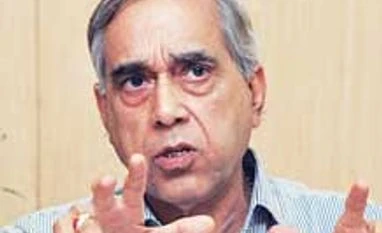
Nripendra Misra
Misra will be the most crucial member of the Modi PMO. The principal secretary is the most important cogs in the administrative wheel at Raisina Hill. The power of a principal secretary is directly proportional to the clout that his boss, the prime minister, wields. He is the key bureaucratic link between the prime minister and senior ministers and secretaries to the government and has substantial influence on policy making.
People who have known Misra from his days in Uttar Pradesh and in Delhi credit him with being an efficient, pro-business administrator. He rose to prominence as principal secretary in Mulayam Singh Yadav's government in Uttar Pradesh in 1990. He fell out with Yadav during BJP leader Lal Krishna Advani's Rath Yatra of the same year. According to a commentator, Yadav wanted to arrest Advani while his entourage traversed Uttar Pradesh. He mulled the decision with the state police chief and chief secretary. Both understood the mood of their political boss and agreed that the state government could arrest Advani. Yadav sent for Misra to seek his advice. Misra, to the surprise of the three men, disagreed. He said the government had no "cause" to arrest Advani because the leader hadn't explicitly preached disharmony. Yadav got angry at Misra, but the bureaucrat was saved the former wrestler's wrath when the phone rang with Janata Dal leader and Yadav's mentor, Chandra Shekhar, on the line. He also advised Yadav against arresting Advani. Mulayam relented. Some days later, then Bihar chief minister Lalu Prasad arrested Advani and was lionised for it. Mulayam has never forgiven Misra for this.
The Mulayam government fell soon after. Kalyan Singh formed the next BJP government, and Misra, who by then had enough friends in the party, continued as the principal secretary. Singh was a votary of administrative reforms, and Misra convinced him to introduce a single window scheme to approve investment projects. But as principal secretary Misra also ruffled enough feathers, particularly of BJP and Rashtriya Swayamsevak Sangh cadres, by not obliging them. RSS's Hindi mouthpiece, Panchajanya, even carried an article that alleged Misra had "proximity to the US" because he was seen with some Americans. A reluctant Singh succumbed to the pressure from within the party and transferred Misra to head the Greater Noida Authority.
Misra would have been the cabinet secretary (the senior-most bureaucrat of the country) if the National Democratic Alliance had returned to power in 2004. But that was not to be. Misra was the telecommunications secretary under Dayanidhi Maran and is credited with the broadband policy. He was the Telecom Regulatory Authority of India chairman when Andimuthu Raja awarded telecom licences on a first come first serve basis. Misra claimed the regulator had instead recommended auction to distribute spectrum.
Ajit Doval
Doval is a rare Indian Police Service officer to have got a military honour, the Kirti Chakra. In 2004, Doval was well placed to head the Intelligence Bureau as its director. But there started a whisper campaign that the Manmohan Singh government would deny him the coveted post because of his proximity to Advani. Despite the campaign, mostly from within the Congress, Singh appointed Doval. He served in the post until early 2005. After retirement, Doval continued to help Indian intelligence agencies with inputs on covert operations.
Doval was India's lead negotiator when an Indian Airlines flight (IC-814) was hijacked to Kandahar. He is credited with having played a key role in the Mizo Accord of 1985, which ended militancy in Mizoram. He spent months with the Mizo National Army in the Arakans in Myanmar and inside Chinese territory. Doval spent several years in Pakistan. In 1989, he was inside the Golden Temple in Amritsar when the Indian army stormed it. He had posed as an agent of Pakistan's Inter-Services Intelligence and supplied the militants with bombs that were used to rig the building before the Army entered. The bombs turned out to be duds. Later, Doval authored a paper on black money which helped Advani rake it as a big issue in the 2009 elections.
Sharma has been Modi's trusted bureaucrat from his very first months as the chief minister of Gujarat. Sharma was appointed secretary in the chief minister's office in 2001, and has never been posted outside it even for a day. Sharma, known as an efficient 'organiser' or 'implementer', is credited with the successful projection of Modi's image as a business friendly politician. Sharma was the bureaucrat behind the Vibrant Gujarat Summits and the International Kite Festivals. His work was to handle industry issues and organise Modi's political meetings as also his meetings with foreign dignitaries. He was constantly on Modi's side whenever he travelled abroad.
Bharat Lal, for the last four years, was the resident commissioner of Gujarat in New Delhi. He was considered Modi's eyes and ears in the national capital, somebody who kept in touch with the national media and key bureaucrats. Others Modi may bring from Gujarat include the state's public relations officer, Jagdish Thakkar, and Hiren Joshi, who handled Modi's social media outreach.
Thakkar, in his late 60s, retired a decade ago as the Gujarat Government's public relations officer but Modi insisted that somebody as good at his job as Thakkar should continue working as a consultant with the government. In his long career, Thakkar has served the dozen-odd chief ministers that Gujarat has seen since 1980, whether from the Congress or BJP and even the odd Janata Dal leader. Thakkar has a knack of understanding what his boss wants to convey in a press release or an advertisement. He approves the release of any press statements, speeches of Modi or advertisements released by Gujarat government.
Back home, Thakkar would accompany Modi on all his tours, including assembly election campaigns. Sources say Modi appreciated Thakkar's speed and accuracy. He would be ready with a press statement based on Modi's speech within minutes of the leader concluding his address. He would hand over the handwritten sheaf of papers to state information department officials for them to get them typed and released to the media. Sources close to him say Thakkar's profile is likely to remain the same in the PMO. The only adjustment Thakkar needs to make would be to move from handling Gujarati content in his state to Hindi and English in Delhi.

 "Modi's handpicked men")


 Connect with us on WhatsApp