A splash of white and orange greets the eye as soon as one enters the swanky new gallery space at The Claridges, New Delhi. These are signature Saffronart colours, which are in evidence everywhere - on the window shades, the walls and in the office space.
Located in the heart of Lutyens' Delhi and spread across 3,000 sq ft, the gallery has been designed as a multidimensional space, one that can be used for auctions, exhibitions, talks and events. The neutral colours and the minimalistic look allow for the gallery to be customised according to the event taking place.
This is not the first gallery opened by the auction house in Delhi. It used to have one at The Leela, which has been closed down as the hotel is undergoing renovation. "But this is the first state-of-the-art space that we have opened in the capital," says Hugo Weihe, CEO, Saffronart. The space is wired up, there is an option for live streaming and there are multiple lines for phone bidding.
The idea of this gallery ties up with the overall feel of Saffronart's flagship space in Mumbai, which opened in December last year. It allowed Saffronart to bring its auctions out of the ballrooms of five-star hotels into a specially designated space of its own. The Mumbai gallery is going to be renovated next year, says Dinesh Vazirani, co-founder of the auction house. "Both the Delhi and Mumbai spaces are being looked upon as destinations -places where people congregate and learn about Indian art," he adds. There will be extensive libraries and an outdoor space with cafes as well.
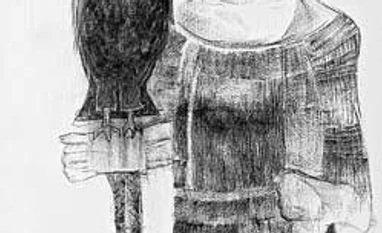
The new gallery in Delhi opens with an exhibition of Krishen Khanna's 24 landmark monochromatic works. "He is one of the last few Progressive artists remaining [others being Ram Kumar and Akbar Padamsee]," says Weihe. Some of these works - especially the ones in charcoal - have not been viewed as much in the past as Khanna's iconic Bandwallah series. These trace his lifelong fascination with the marginalised, overlooked human figures such as waiters at a dhaba or labourers sleeping under trucks.
Krishen Khanna’s Benediction in the Battlefield
"One of the key moments that he draws from is Mahatma Gandhi's assassination, when he saw everyone on the road reading newspapers," says Weihe. "Then, during Partition, he observed people moving away with their belongings. These are very strong, powerful works."
The exhibition will be followed by a show on Ram Kumar at the end of November.
In the middle of the two exhibitions on the Progressive artists, there will be another show - a collaboration with five galleries including Nature Morte, Vadehra, Shine Empire and Espace. This is in sync with the auction house's vision to create an exchange between various players in the art market - one of the ways being renting out space to other galleries on favourable terms.
"Though we work predominantly with the secondary market, we also want to support the primary market with exhibitions," says Weihe. Getting galleries to share space allows for different strategies and formats. For instance, the show with the five galleries is being planned like a mini art fair.

 "The auction block")


 Connect with us on WhatsApp