
Will a volatile rupee make the Indian market even more volatile?
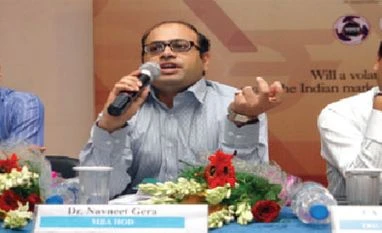
Business Standard Smart Business event held on 19th July 2013 in Delhi in association with Voice Society & Lions Club.
 "Will a volatile rupee make the Indian market even more volatile?")
WebinarsNew
Deep DiveNew
Explore Business Standard
Business Standard Smart Business event held on 19th July 2013 in Delhi in association with Voice Society & Lions Club.
From left to right Mr. Neeraj Chauhan, CFA & Director of The Financial Mall, Dr. Navneet Gera, Associate Professor of Bharati Vidyapeeth Institute of Management and Mr. Amit Gupta, CA & Director of TRIUMPH Financial Services at the Business Standard Smart Business event held on 19th July 2013 in Delhi in association with Voice Society & Lions Club.
Considering the current financial crisis faced by the nation, Dr. Nitin Nayek, Director of BVIM, inaugurated the workshop by highlighting the reasons behind the stunted growth of the Indian economy. “In 1917, one INR was 13 against USD. In 2013, it’s almost Rs.60 against one USD as we are importing crude oil at a larger scale. In 1975, the crude oil rates were 7.52 USD per barrel, but in 2013 it’s almost 94 USD. All this is affecting our economic growth.”, he said.
Dr. Navneet Gera, Associate Professor of Bharati Vidyapeeth Institute of Management, spoke of Rupee hitting an all-time low of 59.77 against Dollar. He further added that with inflation rates being high in India, and economic growth not note-worthy, FII’s are pulling back their money from Indian market, resulting in the scarcity of Dollars. And that’s the reason Indian Rupee is falling down.
Mr. Neeraj Chauhan, CFA & Director of The Financial Mall, said, “Everyone in the society is equally responsible for the scenrio.
The non-earning and the young members should understand that buying foreign products shifts revenue outside our country. Thus, crisis is inevitable.”
Mr. Amit Gupta, CA & Director of TRIUMPH Financial Services, said, “A stagnant economy is dangerous. The weakening rupee has made crude oil, fertilizers, medicines and iron ore, which India imports in large quantities, costlier. With rising fuel prices, the prices of goods that are transported from one part of the country to another, are bound to rise. FMCG such as soaps, detergents, deodorants and shampoos, of which crude oil is an input, are likely to become more expensive.”
He spoke of India’s ‘passion for gold’ which is responsible for the high current account deficit.
Mr. Singla, Member of Lions Club, explained how Indian citizens can assist the Government in achieving economic growth. According to sources, Indians only show 25% of their income as white. If we show our 75% of the black money as white, Indian economy would progress immensely.
First Published: Dec 12 2013 | 5:49 PM IST


 Connect with us on WhatsApp