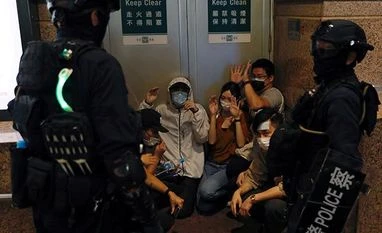
Social media platforms and messaging apps including Facebook, WhatsApp, Telegram, Google and Twitter say they will deny law enforcement requests for user data in Hong Kong while studying ramifications of a national security law enacted last week.
Facebook and its messaging app WhatsApp said in separate statements Monday that they would freeze the review of government requests for user data in Hong Kong, pending further assessment of the National Security Law, including formal human rights due diligence and consultations with international human rights experts.
The policy changes follow the rollout last week of laws prohibiting what Beijing views as secessionist, subversive or terrorist activities, or as foreign intervention in the territory's internal affairs.
The legislation criminalizes some pro-democracy slogans like the widely used Liberate Hong Kong, revolution of our time, which the Hong Kong government says has separatist connotations.
The fear is that the new law erodes the freedoms of the semi-autonomous city, which has operated under a one country, two systems" framework after Britain handed the colony to China in 1997.
That framework has allowed Hong Kong and its people freedoms not found in mainland China, such as unrestricted internet access.
Spokesman Mike Ravdonikas said Monday that Telegram understands the importance of protecting the right to privacy of our Hong Kong users.
Telegram has been used broadly to spread pro-democracy messages and information about the protests in Hong Kong.
Telegram has never shared any data with the Hong Kong authorities in the past and does not intend to process any data requests related to its Hong Kong users until an international consensus is reached in relation to the ongoing political changes in the city, he said.
Twitter also paused all data and information requests from Hong Kong authorities after the law went into effect last week, the company said. It is studying the implications of the security law.
Like many public interest organisations, civil society leaders and entities, and industry peers, we have grave concerns regarding both the developing process and the full intention of this law, the company said in a statement.
Twitter emphasized that it was committed to protecting the people using our service and their freedom of expression.
Likewise, Google said in a statement that it too had paused production on any new data requests from Hong Kong authorities and will continue reviewing details of the new law.
Social platforms such as Facebook, Instagram, Twitter, and WhatsApp have operated freely in Hong Kong, while they are blocked in the mainland by China's Great Firewall.
Though social platforms have yet to be blocked in Hong Kong, users have begun scrubbing their accounts and deleting pro-democracy posts out of fear of retribution. That retreat has extended to the streets of Hong Kong as well.
Many of the shops and stores that publicly stood in solidarity with protesters have removed the pro-democracy sticky notes and artwork that adorned their walls.
Hong Kong's government late Monday issued implementation rules of Article 43 of the national security law, which give the city's police force sweeping powers in enforcing the legislation and come into effect Tuesday.
Under the rules, platforms, publishers and internet service providers may be ordered to take down any electronic message published that is likely to constitute an offence endangering national security or is likely to cause the occurrence of an offence endangering national security.
Service providers who do not comply with such requests could face fines of up to 100,000 Hong Kong dollars ($12,903) and receive jail terms of up to six months.
Individuals who post such messages may also be asked to remove the message, or face similar fines and a jail term of one year.
Critics see the security law as Beijing's boldest step yet to erase the legal firewall between the former British colony and the mainland's authoritarian Communist Party system.
One subscription. Two world-class reads.
Already subscribed? Log in
Subscribe to read the full story →
Smart Quarterly
₹900
3 Months
₹300/Month
Smart Essential
₹2,700
1 Year
₹225/Month
Super Saver
₹3,900
2 Years
₹162/Month
Renews automatically, cancel anytime
Here’s what’s included in our digital subscription plans
Exclusive premium stories online
Over 30 premium stories daily, handpicked by our editors


Complimentary Access to The New York Times
News, Games, Cooking, Audio, Wirecutter & The Athletic
Business Standard Epaper
Digital replica of our daily newspaper — with options to read, save, and share


Curated Newsletters
Insights on markets, finance, politics, tech, and more delivered to your inbox
Market Analysis & Investment Insights
In-depth market analysis & insights with access to The Smart Investor


Archives
Repository of articles and publications dating back to 1997
Ad-free Reading
Uninterrupted reading experience with no advertisements


Seamless Access Across All Devices
Access Business Standard across devices — mobile, tablet, or PC, via web or app
)