Skill vs chance argument weighs as Indian states mull banning online gaming

Blanket curbs could be ignoring the potential offered by a sector that grew by 17% CAGR between 2016-2020, and could reach $2 billion by 2023
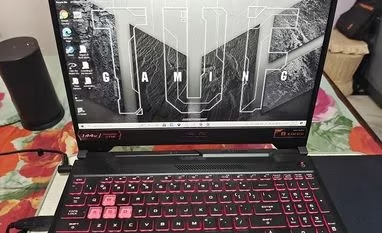
Asus TUF A15 gaming laptop
Representative image
Neha Alawadhi New Delhi
6 min read Last Updated : Oct 19 2021 | 9:18 PM IST
Game of chance or game of skill? That is the age-old question the Indian online gaming industry has been battling for long now. With more and more states considering bans on online gaming, the issue to ponder over is whether or not regulation is taking into account the immense potential of the sector.

Many states have taken steps to regulate or ban online gaming, stemming from the thought process that all online gaming is akin to gambling, or that they are addictive and cause financial losses and suicides. While these are all serious reasons and concerns, are blanket bans a solution?

"One of the reasons for regulators to consider bans is the possibility of financial losses," said Jay Sayta, technology lawyer. "Further, players could be going overboard, and there have been incidents of people committing suicide, borrowing money to pay to play, and so on. It is more from that policing and law and order perspective in maintaining the balance in the families that (online gaming) regulation is being framed," he added. 

However, with more and more states considering blanket bans, business sentiment takes a hit. "There is uncertainty in the industry and business environment for sure. There is a feeling of being jittery--even on issues like taxation. And, of course, investors and the companies themselves are jittery," said Sayta.

It was reported on Tuesday that the government could be considering a single tax rate for online gaming instead of 18 per cent for games of skill and 28 per cent for games of chance.

Dinker Vashisht, Vice President, Corporate Affairs at online gaming company Games24X7 said: "There are concerns that are attributed to the sector, but many of these are also anecdotal in nature. They are not necessarily very clear. The industry is very clear in its mind that it wants to be regulated. It is one of the very few sunrise sectors which is open to being regulated." 

Backed by Tiger Global and The Raine Group, Games24X7 includes skill games RummyCircle and My11Circle and casual games like Ultimate Games in its portfolio. 

"Some of the recent judgments, most notably the judgment of the Kerala High Court (in September), which came close on the heels of the Madras High Court verdict, said that it is wrong to categorise legitimate business activity of game of skill with gambling and betting," Vashisht added.

Because gaming is a state subject, different Indian states are looking at it differently. 

Recent examples of states imposing bans include the Karnataka Police (Amendment) Act that earlier this month outlawed all forms of online gaming where transfer of money is involved, the Tamil Nadu government's law that banned online games such as rummy, poker and other skill-based games that involve betting and money prizes, but was revoked in August. Other states that have clamped down on the industry include Telangana, Andhra Pradesh, Kerala, Assam and Odisha.

Some North Eastern States like Nagaland, Sikkim, Meghalaya have progressive regulation around online gaming. 

"This is just a reflection of some of the newer business models, where there is a technology layer, and how you think about regulation. For the Government to come to a good understanding of the risks and getting the law right, is a challenge in the initial stages. This is problematic for the industry. We need the law to be confidently saying that it is only prohibiting game of chance and not game of skill," said Ashish Agarwal, Vice President and Head of Public Policy at industry body National Association of Software and Services Companies. 

Explaining the conundrum at the heart of the issue, Legal Bites, a law education platform explains in a blog post from earlier this year: "In India, casino games are divided into games of skill and games of chance. Games of skill are okay to bet on, while games of chance are not. Games of skill are games where you play against other players and where you can apply a strategy. Games of chance are games where you play against “the house” and where a strategy won’t help you. However, what games are classified as games of skill or games of chance are not entirely easy to understand."

Games like online Rummy, poker, fantasy sports, and e-sports have all been found to be games of skill by various High Courts and the Supreme Court in India. With the rise of online gaming in India, especially more so post the pandemic, newer games and genres have made an appearance in the business.

The Indian online gaming sector reached $1.03 billion in 2020, a growth of over 17 per cent from $543 million in 2016, according to the EY-All India Gaming Federation (AIGF) report "Online gaming in India-–The GST conundrum."

At the current rate, the sector is expected to reach $2 billion by 2023 in terms of fees earned. Online gamers in India are estimated to grow from 360 million in 2020 to 510 million in 2022. Additionally, there are over 400 gaming start-ups at present that are accelerating the growth of the sector.

"In the recent past, we have seen a mixed bag of results for game development in India with regulatory changes. Naturally, the suspension of Chinese apps and games from app stores created room for local app developers to gain traction in India. Similarly, a lot of judgements have been passed in recent times that favour skill-based real money gaming. Most skill-based real money gaming platforms, like MPL and SkillClash, use games developed by third-party game developers," said Gaurav Agarwal, co-founder, Gamezop, a casual gaming arcade and gaming solutions provider. 

Nasscom's Agarwal feels the issues around regulation of online gaming can be resolved with the right precedents. 

"In this ongoing issue, in addition to getting the law right, more awareness is required from a law enforcement agencies' perspective, to really be able to distinguish between game of chance and game of skill. Else, the entire gaming industry will continue to face some challenge to prove that they are not a game of chance. There is enough knowledge available through Supreme Court and High Court judgments, where it's abundantly clear what should be covered by law while seeking to ban certain kinds of games," he said.

One subscription. Two world-class reads.

Already subscribed? Log in

Subscribe to read the full story →
*Subscribe to Business Standard digital and get complimentary access to The New York Times

Smart Quarterly

₹900

3 Months

₹300/Month

SAVE 25%

Smart Essential

₹2,700

1 Year

₹225/Month

SAVE 46%
*Complimentary New York Times access for the 2nd year will be given after 12 months

Super Saver

₹3,900

2 Years

₹162/Month

Subscribe

Renews automatically, cancel anytime

Here’s what’s included in our digital subscription plans

Exclusive premium stories online

  • Over 30 premium stories daily, handpicked by our editors

Complimentary Access to The New York Times

  • News, Games, Cooking, Audio, Wirecutter & The Athletic

Business Standard Epaper

  • Digital replica of our daily newspaper — with options to read, save, and share

Curated Newsletters

  • Insights on markets, finance, politics, tech, and more delivered to your inbox

Market Analysis & Investment Insights

  • In-depth market analysis & insights with access to The Smart Investor

Archives

  • Repository of articles and publications dating back to 1997

Ad-free Reading

  • Uninterrupted reading experience with no advertisements

Seamless Access Across All Devices

  • Access Business Standard across devices — mobile, tablet, or PC, via web or app

Topics :online gaming

Next Story



