In Praise of Coalition Politics and Other Essays on Indian Democracy
Come election season, and publishers waste no time in rolling out books by or about politicians, both dead and alive. It is, undoubtedly, the perfect moment to shape public opinion about various candidates, parties and ideologies that are eager to impress voters and secure their loyalty.
Member of Parliament (Rajya Sabha) Manoj Kumar Jha’s In Praise of Coalition Politics and Other Essays on Indian Democracy, a collection of previously published writings revised for this volume, arrived just ahead of the recent Vidhan Sabha elections in Bihar. The timing is hard to ignore, while reading the pieces compiled in the book. His party, the Rashtriya Janata Dal (RJD), has much soul-searching to do after its coalition with the Indian National Congress (INC) and other Mahagathbandhan partners failed to impress voters. Their manifesto promised employment, improved governance, better infrastructure and social welfare but the electoral results were appalling.
Mr Jha’s essays offer a useful entry point for thinking about what might have gone wrong. He draws a sharp distinction between coalitions that “challenge the status quo” and coalitions that are “stitched together only to hold on to power”. Unsurprisingly, he casts the Mahagathbandhan in the former role and the National Democratic Alliance (NDA), comprising the Bharatiya Janata Party, Janata Dal (United), Lok Janshakti Party and others, in the latter. That the Mahagathbandhan has failed to shake up the status quo is evident, but the electoral setback does not diminish the value of Mr Jha’s broader reflections on democracy’s past, present and future.
Pushing back against the cynical view that coalitions exist only to gather the requisite number of seats to claim a majority and form a government, Mr Jha highlights their potential as a “safeguard against democratic erosion”. At the risk of antagonising the INC, he valorises the Janata Party coalition’s landslide victory in 1977 as a democratic corrective after “the dark period of the Emergency that was imposed by an increasingly autocratic Indira Gandhi in 1975”.
Mr Jha also points to V P Singh’s National Front government (1989–90), which propelled leaders like Lalu Prasad Yadav and Mulayam Singh Yadav onto the national stage, “spotlighting the Mandal Commission’s recommendations for reservations for Other Backward Classes (OBCs)”. These examples lend heft to Mr Jha’s claim that coalitions can keep majoritarianism in check.
Yet this book does not dwell on how coalitions formed for principled reasons can resist and eventually defeat coalitions that are rooted in “electoral arithmetic”. The proof of the pudding, as they say, is in the eating, so a coalition like the Mahagathbandhan might need to get a grip on why they have been unable to attract a broader spectrum of voters, and close the gap between intention and impact.
Mr Jha’s critique of the BJP’s “One Nation, One Election” proposal is well-articulated. He believes that the idea to “synchronize elections for the Lok Sabha and all State legislative assemblies” in order to “improve governance, reduce electoral costs and free the polity from constant-election mode distractions” would help national parties and put regional parties at a disadvantage.
This is not empty rhetoric. It is grounded in examples such as the Tamil Nadu state legislature’s rejection of the Centre’s three-language formula mandating the use of Hindi, English and the regional language in school education. While Mr Jha’s defence of federalism is certainly persuasive, he does not really engage with concerns around electoral expenditure.
What stands out is his cautionary note that “there is more to democracy than going out to vote and electing one’s representative”. He makes a compelling case for protests, public mobilisations and continuing dialogue between elected representatives and citizens. In doing so, he underlines a fundamental truth: Democracy thrives when politically active citizens hold leaders accountable.
In addition to the essays, the book carries a set of open letters that offer a more intimate view of Mr Jha’s ideological and emotional landscape as a politician. In the one addressed to Pandit Jawaharlal Nehru, he writes, “Those at the regime’s top have transmogrified themselves into historians with a perverted love of counterfactuals, brutalizing our memory by pitting you against your long-term comrade Sardar Vallabhbhai Patel.” His anguish is directed towards the dead as the living have grown intolerant of critique even when it springs from love for the nation.
The grief intensifies in his letter to M K Gandhi, where he observes that “...those who call your assassin a ‘patriot’ are now inside Parliament.” His mourning for the loss of what India used to be is a recurrent theme in the book. It comes up again in his letter to the people of Palestine, where he writes, “The people of India — who have known colonization, partition and displacement — cannot afford to look away.” By speaking up for Palestine, Mr Jha insists that our commitment to democracy as Indians must extend beyond our own territorial boundaries.

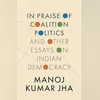 "Manoj Kumar Jha's book explains hope versus reality in coalition politics")










 Connect with us on WhatsApp