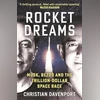
ROCKET DREAMS: Musk, Bezos, and the Inside Story of the New, Trillion-Dollar Space Race
by Christian Davenport,
Published by Crown
Currency
371 pages, $32
REBECCA BOYLE
When the rocket company Blue Origin didn’t get a lunar lander contract with NASA in April 2021, its founder, Jeff Bezos, was fuming. Blue Origin had been working for years on a prototype lander, hoping to wrest funding — and some fame — from Elon Musk’s SpaceX, by then a trusted partner to the American space agency. Just four months into the Biden administration, Bezos began assembling attorneys to file a formal protest with the federal government. According to the journalist Christian Davenport’s latest dispatch from the high-tech space race, Rocket Dreams, Bezos also posed a question: “How would we go about this if NASA did not exist?”
The answer: Build big rockets that can get people to the moon (and Mars) anyway. Billionaires just really want to do that. They have plenty of money to spend and nobody is stopping them; in fact, NASA is welcoming their ideas and their designs. What no one asks, including in this book, is why this is something we should encourage the billionaires to do, let alone why we should praise them for it.
As the space exploration beat writer at The Washington Post, Davenport is in frequent contact with the government space officials, tech bros and billionaires who are transforming the industry — including Bezos, who owns Davenport’s employer. Rocket Dreams offers a fly-on-the-wall account from launchpads and flight decks across nearly a decade of space exploration, from the early days of the first Trump administration to the beginning of the second.
Davenport is impressively sourced and his book is a fine piece of reporting; historians will be able to use this first draft of rocket history to craft deeper analyses of our first real steps as a space-faring society.
At the centre of these unfolding events lie Bezos and Musk. Davenport’s portraits of them are frequently sympathetic, even complimentary. At the helm of a meeting between NASA and Blue Origin in 2017, Bezos is described as “a self-taught rocket scientist who could keep up with even the best of his engineers.”
Meanwhile, at a giant rocket facility being built in Boca Chica, Texas, around 2018, we hear John Muratore, the NASA engineer turned SpaceX launch director, tell Davenport that Musk would “look at everything, climb around” and “constantly” have “great suggestions.” Fearful of telling Musk that anything is impossible, the SpaceX team in Boca Chica worked 16 hours a day, seven days a week, and slept in cars on-site. But even this is framed as a positive. “It was an amazing few months,” Muratore recalls.
Criticism does crop up — Davenport includes his reporting on sex-discrimination complaints against Blue Origin, for instance — but the overall picture is of two visionary men committed to getting humans and eventually industry off this planet and among the stars. Musk comes off as a workaholic and a maniacally committed true believer, even as he buys Twitter and slouches toward far-right conspiracy theories and anti-immigrant rhetoric. Bezos seems like a sincere, patriotic, steadfast track-layer who can never seem to outdo his rival.
Neither one of them is the heel of this story, however; that role falls to the NASA administrator Jim Bridenstine. After Musk smokes weed on Joe Rogan’s podcast in 2018, Bridenstine orders an investigation of SpaceX’s work safety culture. The relationship between Musk and NASA begins to deteriorate. In 2019, Bridenstine bristles publicly about Musk’s obsession with Starship — a mega rocket that could theoretically get humans to Mars — which the tech mogul seems to pursue at the expense of NASA’s more immediate concerns, namely, preparing to deliver astronauts to the International Space Station as SpaceX had promised to do.
This tension does not last. Musk surprises Bridenstine by doing just what the NASA administrator wants: making some tweaks to the commercial crew capsule and getting it ready to fly. The NASA administrator “was starting to see him in a different light, as someone who would get things done. As someone he could trust.”
The space race between Bezos and Musk often does not feel like an adventure, or an elevation of the human spirit. In Davenport’s straightforward, journalistic telling, it is more like a cynical quest for likes and power.
Only a few months ago, Musk and Trump seemed aligned on the goal of putting human beings on Mars. To Trump, Davenport explains, “Mars was Fifth Avenue,” prime real estate. But Musk’s relationship with the president began to crumble this spring and Musk’s pick for NASA administrator, Jared Isaacman, was yanked out of the running. Mars might as well be in Yonkers now.
The reviewer is the author of Our Moon: How Earth’s Celestial Companion Transformed the Planet, Guided Evolution, and Made Us Who We Are.
©2025 The New York Times News Service