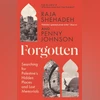
'Forgotten': A journey through Palestine's lost history and erased identity

Two West Asian commentators take a walk through remote parts of historic Palestine, and every discovery they make is a story of loss, erasure, and a denial of identity

BOOK
Talmiz Ahmad
5 min read Last Updated : Mar 03 2025 | 11:47 PM IST
FORGOTTEN: Searching for Palestine’s Hidden Places and Lost Memorials
Author: Raja Shehadeh & Penny Johnson
Publisher: Profile Books
Pages: 228
Price: Rs 699
  Amidst the present-day death and destruction in West Asia, the distinguished commentators on Palestinian history and politics, Raja Shehadeh and Penny Johnson, describe in Forgotten the walking tours they had undertaken between 2021 and 2023 to remote parts of historic Palestine. They had then removed rubble and foliage in obscure places to trace Palestinian lives which, from 1948, have been extinguished by war and replaced by new inhabitants and settlements that deny the earlier pervasive presence of Palestinians on these lands. Every discovery is a story of loss, erasure and denial of identity.
 
In contrast to the ghettoised lives of most Palestinians in contemporary times, historic Palestine was for millennia at the crossroads for the movement of armies, traders, preachers, pilgrims, and ordinary workers across West Asia, supported by numerous khans  or roadside inns. The Via Maris (“the Way of the Sea”) had, for 5,000 years, linked Egypt with Damascus and beyond, making Palestine a “land bridge” between Africa and Asia.
 
The town of Nablus in the West Bank was for several centuries a centre of commerce and manufacture and was associated with the Romans, Islam, the Crusades, the Ottomans, and later, as the authors point out, was “a centre of resistance to the Israeli occupation”. On the outskirts of the town, the writers discovered a cemetery with several hundred graves of Iraqi soldiers who had died in the 1948 war. Again, hidden behind palm trees and a stone wall, the authors found the graves of Jordanian soldiers killed in the same war.
 
The authors’ journeys take them to El-Jib in the West Bank, which, in its time, had outshone Jerusalem. It had an advanced water supply system and was known for its export of wine. A British traveller in the 19th century described its valleys and plains as “full of grain, vineyards and orchards of olive and fig trees,” which made it “the finest part of Palestine”.
 
After a difficult search in western Jerusalem, Mr Shehadeh and Ms Johnson find the mosque and tomb of Nabi Ukkasha who had come to Jerusalem with Caliph Omar in the seventh century. The writers recall that the compound of the saint’s mausoleum is said to have the graves of prophets from the Jewish, Christian and Islamic traditions. Later, they discovered the neglected mausoleum of Nabi Ayoub (the Biblical prophet Job) on the outskirts of Ramallah.
 
The authors look for memorials to the Nakba, the “catastrophe” of 1948 that has erased Palestine from most maps and made its displaced people exiles, refugees or second-class denizens in their occupied homeland. This effort is difficult and always personally painful. Over 400 Palestinian villages were erased in 1948-49; several hundred persons were massacred, while 750,000 were forced into exile.
 
Every spot associated with earlier Palestinian life identified by the authors yields evidence of cruel killings, the deliberate obliteration of the village, and the construction of Jewish habitations on its ruins. The writers quote the Palestinian poet Taha Mohammed Ali as saying: “[T]here isn’t a single sign left to guide us or show us a thing.” But Taha speaks on behalf of the displaced when he still firmly asserts: “We will not leave.”
 
Memorials commemorating the  Nakba  are few and do no justice to the enormity of the tragedy. The village of Kfar Kanna is near Nazareth, where Jesus had turned water into wine for a wedding celebration. In 1948, it was hit by air strikes and levelled; its 5,000 residents were exiled to Lebanon or made homes in neighbouring villages. The site of the destroyed village has a rare commemorative pillar that refers to Kfar Kanna as the “wounded bride of Galilee”. It is adorned with a Koranic verse that reads: “And reckon not those who are killed for Allah’s sake as dead, they are alive.”
 
The town of Manshiya on the Mediterranean, between Tel Aviv and Jaffa, had, in 1944, about 12,000 Arabs and 1,000 Jews, and was a thriving commercial centre. It was destroyed in 1948 and, the authors say, became “the ultimate site of urban erasure”. Its space is now occupied by a park for joggers, cyclists and dog walkers.
 
The story of Israel and the occupied territories over the last decades is defined by a recurring pattern of division and conflict that has shaped Israeli-Palestinian encounters over several decades. It is ironic that today, without addressing Palestinian aspirations, Israel is seeking to link itself with West Asia through the India-Middle East- Europe Economic Corridor (IMEC), a ship and rail connectivity project. Just a hundred years ago, a railway network had linked the principal cities of West Asia — Amman, Basra, Beirut, Cairo, Damascus, Jerusalem and Medina — to Istanbul. Such connectivity projects will be successful only when there are fruitful ties between the peoples of the region.
 
The musings of the authors after their odyssey through their tormented land are anguished. They mourn that the Arabs and Israelis recall two different parts of the same story — as the Israelis celebrate the achievement of statehood in 1948, the Palestinians recall the pain of the loss of home, heritage and identity.  For now, they are only linked by what the Irish poet, Willie Doherty, called: “The problem with forgetting/ The problem with remembering.”
 
The reviewer is a former diplomat

One subscription. Two world-class reads.

Already subscribed? Log in

Subscribe to read the full story →
*Subscribe to Business Standard digital and get complimentary access to The New York Times

Smart Quarterly

₹900

3 Months

₹300/Month

SAVE 25%

Smart Essential

₹2,700

1 Year

₹225/Month

SAVE 46%
*Complimentary New York Times access for the 2nd year will be given after 12 months

Super Saver

₹3,900

2 Years

₹162/Month

Subscribe

Renews automatically, cancel anytime

Here’s what’s included in our digital subscription plans

Exclusive premium stories online

  • Over 30 premium stories daily, handpicked by our editors

Complimentary Access to The New York Times

  • News, Games, Cooking, Audio, Wirecutter & The Athletic

Business Standard Epaper

  • Digital replica of our daily newspaper — with options to read, save, and share

Curated Newsletters

  • Insights on markets, finance, politics, tech, and more delivered to your inbox

Market Analysis & Investment Insights

  • In-depth market analysis & insights with access to The Smart Investor

Archives

  • Repository of articles and publications dating back to 1997

Ad-free Reading

  • Uninterrupted reading experience with no advertisements

Seamless Access Across All Devices

  • Access Business Standard across devices — mobile, tablet, or PC, via web or app

Topics :BS Opinionpalestine

Next Story