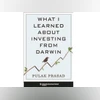
What I learned about Investing from Darwin
Publisher: Columbia Business School Publishing
In their pursuit of profits, investors commit errors that fall into one of two categories. A type I error arises due to an action performed by an individual. An investor, for instance, may bet on a stock he should have avoided. A type II error, on the contrary, arises due to an action an individual fails to take, such as an investor missing out on a stock to which he should have latched on. A hyper-aggressive investor risks committing too many type I errors. His conservative peer risks ending up with an unpalatably high percentage of type II errors. An ever-present dilemma in investing is whether to pursue gains aggressively or protect the downside.
In the animal kingdom, a deer would commit a type I error by visiting a water hole at an hour when there could be a predator lurking in the vicinity. Deer have survived for millions of years by being hyper-cautious.
Male deer, called stags, have to fight rivals to gain control over a group of female deer. While the upside is control of the harem, the downside is loss of limb, sometimes even life.
Contrary to what one might intuitively believe, a close observation of their behaviour reveals that stags go to great lengths to avoid a duel. The rivals first engage in a roaring match. The quality of the roar is a reliable indicator of a stag’s strength. At the end of the session, one of them typically walks away.
If roaring doesn’t settle the issue, the rivals walk parallel to each other with stiff legs. This spectacle is another display of strength meant to make the rival throw in the towel.
Only if neither stag backs down after these stages does the skirmish begin. Even then, the initial bouts are more of a push-and-shove game. It is only when all these rituals fail to settle the issue that the fight begins in earnest. The bottom line: Animals are extremely wary of committing a type I error.
Minimising type I error comes with a trade-off — it increases the probability of committing a type II error. A deer may end up staying thirsty even when there is no predator near the water hole. By walking away when there is even a small chance of losing, a stag risks surrendering a fight it may well have won.
While being hyper-cautious carries an opportunity cost, on balance, the trade-off has worked well for deer, enabling them to survive for centuries.
Author Pulak Prasad uses the above analogies in the first section of his book, where he urges investors to prioritise risk over return. To buttress his argument, he quotes Warren Buffett who famously said, “Rule number one: Never lose money. Rule number two: Never forget rule number one.”
Mr Prasad asserts that investors, too, should emulate animals and make each investment choice as if their lives depended on it. Alas, the ground reality couldn’t be more different. Many investors pick stocks based on tips and bet their hard-earned money on them without doing even rudimentary research. They trade in and out of stocks as if they were in a casino. Not surprisingly, most end up with losses.
Mutual fund managers don’t fare much better either. Many have egregiously high turnover ratios. As successive SPIVA (S&P Indices Versus Active) reports demonstrate, most lag behind their benchmarks (in the United States and India).
Mr Prasad has harnessed numerous interesting analogies from the field of evolutionary biology to elucidate his investment principles. In the second section, he dwells on the importance, and methods, of buying quality businesses at fair prices. In the final section, he harps on the significance of being very lazy: Having bought a stock, almost never sell it.
But who is the author and why should you read his book? After working with McKinsey and Warburg Pincus, Mr Prasad founded Nalanda Capital in Singapore in 2007. By the time of writing this book, his fund had produced an annualised post-fee return of 20.3 per cent over a 15-year-plus span. If he were a batsman, such performance would place him in the pantheon of greats who average more than 50 in a career spanning over a hundred tests.
Charlie Munger (Berkshire Hathaway’s vice-chairman) once named The Selfish Gene by Richard Dawkins as one of his favourite books. Mr Prasad read it and was hooked on the subject of evolutionary biology. He began by using analogies from this subject to explain his investment principles in his quarterly letters. From those modest beginnings emerged the idea of writing an entire book.
This well-written investment guide from an erudite fund manager holds a treasure trove of wisdom. Serious, long-term, buy-and-hold investors should read it and incorporate its core principles into their investment practice.

 "Investing lessons from evolutionary biology")












 Connect with us on WhatsApp