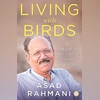
LIVING WITH BIRDS, THE MEMOIR OF ONE OF INDIA'S GREATEST ORNITHOLOGISTS
Author: Asad Rahmani
Publisher: Juggernaut
Pages: 368 Price: ₹599
Asad Rahmani is one of India’s eminent naturalists — an indefatigable bird explorer, and a walking encyclopedia on avian life. Living with Birds, his autobiography, reveals a lot, not only about Indian birds and their conservation during the last half-century but also about a bygone era of field ornithology.
Rahmani was passionate about birds from an early age, and later his passion transformed into his profession. His ornithological journey — as a teenager watching the Brahminy Ducks in the fields near home, to leading one of Asia’s best known natural history institutions, the Bombay Natural History Society (BNHS) — is worth reading about.
His work was rooted in the old-school tradition of natural history based on keen field observation, inspired by the writings of naturalists such as Salim Ali, E P Gee, and M Krishnan. During the course of his long service at Aligarh Muslim University and at the BNHS, Rahmani undertook extensive work on Indian birds. He went on to mentor innumerable ornithologists such as Ravi Sankaran, Iqramul Haque, Goutum Narayan, P Jeganathan, and Usha Lachungpa, who researched some of the rarest and least-studied bird species of the country such as the Bengal Florican, the Ibisbill, Jerdon’s Courser, and the Narcondam Hornbill.
Rahmani’s most significant contribution has been to bring grassland and savannah squarely into the popular conservation discourse. These ecosystems had been relegated to the “wasteland” category by the British, and were largely neglected as hotspots for conservation since the 1800s. Although noted naturalists such as Dharmakumarsinhji and Lavkumar Khacher studied grassland birds during the early 20th century, Rahmani was the first professional ecologist to begin talking about these little-known ecosystems that once covered a major chunk of the Indian subcontinent.
Since the 1980s, his writings on species such as Great Indian Bustard of the desert, and Blackbreasted Parrotbill of the Terai grasslands brought these extreme habitat specialists and their remote habitats onto the radar of national and state governments. In the process, he and his students explored grasslands, thorn scrub, wetlands, marshes, fallows, rivers and agriculture: These terrains were all part of his ambit. His explorations yielded rich dividends; they revealed that open natural ecosystems (ONEs, as they are called now) had their distinct and diverse fauna, and deserved to be studied separately from forests.
Rahmani’s recognition of the possibilities of human-wildlife coexistence in Indian savannahs has also been significant in the context of the dominant discourse of the time. Based on his long-term observations, he pointed out that regulated livestock grazing and use of fire was essential to maintaining the biodiversity of grasslands. His work repeatedly points to the misguided interventions by the Forest Department in grasslands— such as fire suppression, grass harvest bans and tree plantation — all hangovers from the colonial past that adversely affected the species. Interestingly, he writes of a wildlife reserve set up for the Great Indian Bustard — the Karera Wildlife Sanctuary —which lost its flagship species despite protection. He also documents the loss of the Lesser Florican, another endangered species, from the reserves set up for it in Sailana and Sardarpur in Madhya Pradesh.
One of the BNHS’ claims to fame is its critical role in saving endangered vulture species, by now a story very familiar to most Indians. Rahmani was in the hot seat at the time, and helped steer this conservation intervention onto a useful trajectory. News articles and everyday observations spurred Rahmani to investigate the “rumours” about dying vultures. Examination of data collected by his colleague Vibhu Prakash, in the early 2000s, confirmed his worst fears: Vulture numbers showed a sharp decline from 1990-93 to 2000-2003. Further field surveys and lab-based research linked the vulture decline to the use of diclofenac for cattle disease. Subsequently, a captive breeding programme for vultures took shape under his leadership, an ex situ project that still continues.
Rahmani’s memoirs of field work, however, form the most interesting part of the book. He recounts the trials and tribulations of wildlife biologists in the field, which continue to this day. Rahmani talks about the difficulties during his field days in Karera in Madhya Pradesh: “As diesel was not available in Karera at the time, I had to conserve fuel. So, even after completing the morning’s fieldwork, I would remain in the field so that I could study bustards in the evening, sheltering under trees during the hot midday when temperatures would go up to 48o C…When the Forest Department heard that we (myself and Bharat) were sheltering under a tree during the hot hours of the day, the CWLW of MP decided to build a hut for us near Fatehpur village.”
Rahmani’s words reflect the inadequate investment into wildlife conservation back in the 1980s that continues to this day. Field biologists still struggle for resources and remain under-supported, despite the greatly expanded importance of conservation science in current times.
I recommend Asad Rahmani’s memoir: It is highly readable not only for its ornithological details but also its insights into the contemporary history of conservation in India.
The reviewer is an ecologist who works on land-use change impacts, ornithology, and wildlife policy in India. She is currently a visiting professor in the Department of Environmental Studies at Ashoka University