'Tareekh Pe Justice' uncovers institutional failures behind slow justice

The slow pace of our justice system is often blamed on a lack of resources, but Tareekh Pe Justice argues this misdiagnosis hides deeper institutional failures
BOOK
Neha Bhatt
5 min read Last Updated : Mar 20 2025 | 11:27 PM IST
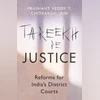
Tareekh Pe Justice: Reforms for India’s District Courts
Author:  Prashant Reddy T and Chitrakshi Jain
Publisher: Simon & Schuster
Pages: 270
Price: Rs 799 
In Tareekh Pe Justice: Reforms for India’s District Courts, authors Prashant Reddy T and Chitrakshi Jain flip the iconic Tareekh Pe Tareekh dialogue from a Hindi film to offer a long-term cure for India’s chronic courtroom ills.
 
Their diagnosis sharply contrasts with the conventional debates on what ails the judiciary. It comes at a time when the sluggish pace of courts no longer raises as many eyebrows, with inertia and apathy baked into the system over decades. There have been occasional calls for change — such as by President Droupadi Murmu, who recently criticised the culture of adjournments, with judgments delivered after a generation had passed, and the judicial process becoming a source of great misery, especially for the poor— but there is little institutional change.
 
The judiciary’s immediate challenges—over 50 million cases pending in courts, with an average of 10 years to resolve each case — have primarily been attributed to overburdened courts and a shortage of resources. The authors, both legal researchers, challenge this popular narrative, offering a compelling counterargument: “The Indian judiciary has been incredibly successful in pushing the ‘resource crunch’ narrative to explain its extraordinary inefficacy.” In reality, both central and state governments have increased the number of judges in the district judiciary from 7,675 to 25,511 between 1987 and 2023, with ~10,000 crore allocated for infrastructure and judicial modernisation since 1993-94. These investments, the authors contend, have had no significant impact on the backlog of cases. Could resource scarcity be a misdiagnosis to escape broader institutional failures?
 
The authors  offer alternative explanations for the staggering delays within the district judiciary, which serves as the first point of contact for most Indian litigants. Through a clear-eyed and assured perspective, supported with minute details of relevant historical cases, Mr Reddy and Ms Jain lay out three key ideas to reform this crucial arm of our judiciary. The tone is consistently prescriptive, urging the higher judiciary to confront its role in shortchanging the lower courts and perpetuating an outdated system. The book advocates a modern, efficient approach that blends valuable lessons from the past with best practices from other countries. The authors pull no punches in holding up an unflinching mirror: “…while the judiciary has been vocal on advocating for transparency in government, it has been hostile to the idea of subjecting itself to external scrutiny”, including undermining the Right To Information Act to keep certain records out of the public eye.
 
The first part of the book focuses on judges, highlighting the key challenges of an unjust system that hampers their efficiency. Central to this is the issue of fear and suspicion, as noted by former Chief Justice D Y Chandrachud a few years ago, which makes district judges risk-averse when handling complex cases. A lack of independence undermines their ability to deliver justice and grant bail particularly in heinous crimes, with the threat of disciplinary action looming large. These cases then have to be heard in higher courts. In the UK and the US, for example, judges have immunity against complaints about their judgments unless there are allegations of corruption or misconduct. Further, a culture of erratic transfer policies and questionable performance assessments has led to cases caught in an endless cycle, bouncing from judge to judge.
 
Also muddying the conversation on judicial reforms in India is “judicial activism” adopted by the higher courts in administering the district judiciary, where complex policy issues are settled through public interest litigation  instead of a more nuanced and participatory approach. The book also flags as a crucial misstep the practice of appointing judges who are inexperienced, with a selection process that is colonial and outdated. The authors suggest a full-time commission for the district judiciary to screen complaints and inquiries independent of the high courts.
 
The second part of the book focuses on the granular aspects of judicial statistics and budgets and the culture of opacity “cultivated at the highest levels of the institution.” Of particular concern is the decline in the quality of data necessary to assess existing gaps, including flaws in the National Judicial Data Grid, a repository under the e-Courts project. The book suggests practical ways to pressure the judiciary into producing accurate statistics to measure performance and hold individual judges accountable for delays. Better mechanisms to collect data, for example, will help arrive at a formula to assess how many judges India actually needs without using the flawed methodology of basing it on population, they believe. Contrary to the traditional narrative, the judiciary’s call for greater financial autonomy is a dangerous proposition without a commitment to improved efficiency, they add. Another critical issue highlighted is the failure to digitise workflows in district courts, as has been done in higher courts. The final section of the book floats the idea for a fundamental reimagining of the judiciary’s constitutional design. It proposes splitting India’s unified judiciary system, and, interestingly, reintroducing the jury system—abolished in 1973—to bring the public back into the courtrooms to have a say in how justice is delivered.
 
Tareekh Pe Justice  is a passionate, essential call for reform that has the potential to restore public faith in the system, offering sensible ideas informed by meticulous data and research. While weighty and at times dense, it remains largely accessible with a broader appeal beyond the legal field. The good news is that although the proposed changes will require considerable political and judicial will, the outcome will likely be a win-win for all.
 
The reviewer is a journalist and author
 

One subscription. Two world-class reads.

Already subscribed? Log in

Subscribe to read the full story →
*Subscribe to Business Standard digital and get complimentary access to The New York Times

Smart Quarterly

₹900

3 Months

₹300/Month

SAVE 25%

Smart Essential

₹2,700

1 Year

₹225/Month

SAVE 46%
*Complimentary New York Times access for the 2nd year will be given after 12 months

Super Saver

₹3,900

2 Years

₹162/Month

Subscribe

Renews automatically, cancel anytime

Here’s what’s included in our digital subscription plans

Exclusive premium stories online

  • Over 30 premium stories daily, handpicked by our editors

Complimentary Access to The New York Times

  • News, Games, Cooking, Audio, Wirecutter & The Athletic

Business Standard Epaper

  • Digital replica of our daily newspaper — with options to read, save, and share

Curated Newsletters

  • Insights on markets, finance, politics, tech, and more delivered to your inbox

Market Analysis & Investment Insights

  • In-depth market analysis & insights with access to The Smart Investor

Archives

  • Repository of articles and publications dating back to 1997

Ad-free Reading

  • Uninterrupted reading experience with no advertisements

Seamless Access Across All Devices

  • Access Business Standard across devices — mobile, tablet, or PC, via web or app

Topics :BookBOOK REVIEW

Next Story



