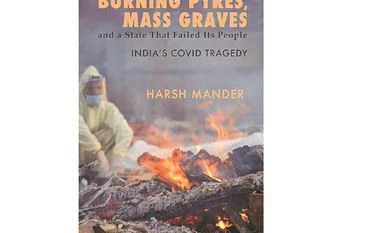
Burning Pyres, Mass Graves and a State That Failed Its People
Publisher: Speaking Tiger
The year was 2020 when the first wave of Covid-19 knocked on India’s doorstep. The initial response from the authorities was complacent, which then had to be compensated for by the knee-jerk reaction of a nationwide lockdown, giving Indian citizens just hours to prepare. This was followed by the second wave the next year, which wreaked havoc on every aspect of our lives.
Much of this trauma is forgotten in the upbeat talk of economic revival and the optimistic narrative of India’s rising geopolitical power. Harsh Mander’s Burning Pyres, Mass Graves and a State That Failed Its People aims at refreshing the collective memory of those difficult times and focusing on the serious policy lapses to ensure that those responsible remain accountable.
The book is divided into two sections that track the two major Covid waves. The first segment delves deeper into the lockdown and how it revealed a tremendous policy failure that caused millions of migrant daily wage workers to cover thousands of kilometres on foot with their children on their shoulders and no support from the state whatsoever. With no preparations to safeguard their food security or labour rights, they were forced to choose between starvation and survival.
This section also reminds us of the communal strain of Covid that was revealed in the initial phases when the government, along with most of the mainstream media, spread the canard that Muslims had been the super spreaders. Burning tickers on news channels showed inflammatory catch phrases such as “Corona Jihad”, “Tablighi Virus” and so on to shift the blame for policy failures on the minority community. This created another layer of mass hysteria, ultimately resulting in cases of violence and discrimination.
If the first wave was bad in terms of preparation and policy implementation, the second wave was even worse. The latter part of the book offers a grim recap of the harrowing experience that ordinary people faced when the Delta version of the virus rampaged through the country. Memorable images of time are of endless rows of dead bodies waiting their turn to be cremated or buried, many of them being handled by unknown people while the less fortunate ones were found floating in the rivers.
This is a difficult section to read because it reprises a time of hopelessness and despair that all Indians shared. Yet while we lost numerous relatives and friends around us every day, the data that was being published showed another story. Mr Mander mentions data journalist Rukmini S’ belief that there’s a “moral responsibility of the living to the dead”. He goes further in the chapter and questions the intent behind the skewed statistics, and presents different narratives from experts to trace the truth.
The Covid-19 pandemic also highlighted the different inequalities that persist in our society. One of them was the digital divide, as all Indian students were expected to effortlessly switch to the online mode of study. The chapter titled “Leaving a Whole Generation Behind” shows how the families of millions of less fortunate students struggled to acquire the requisite smartphone and internet connectivity to gain access to basic education. Stories of students from all over the country portrayed the same predicament, of 17 months lost for a class of people who are already disadvantaged to begin with.
Reading this book made me revisit the time when my day started with arranging a hospital bed for someone and ended with trying to get hold of an oxygen cylinder. It was a time when we got to see the best and the worst in people, many came forward to donate money for distribution of rations amongst the poor while others treated the calamity as an opportunity to mint money from desperate relatives of Covid patients. The “system” that we talk about disintegrated right before our eyes and it made me realise how little we invest in public healthcare.
In the end, Mr Mander focuses on the kindness and solidarity that was shown by many like those who organised the oxygen “langars” or distributed food even when the pandemic was at its peak and identifies these initiatives as representing the true spirit of the country. Through this book, he attempts to touch our better, humane selves, beyond merely grieving and raging against the government.
The reviewer is a writer and translator from Allahabad and a co-founder of RAQS, a collective working in the city on gender, sexuality and mental health

 "Looking back in anger")












 Connect with us on WhatsApp