Growing up, he was called Little Mike, after his father, the Baptist minister Michael King. Only in college did he drop his first name and began to introduce himself as Martin Luther King Jr. This was after his father visited Germany and, inspired by accounts of the reform-minded 16th-century friar Martin Luther, adopted his name.
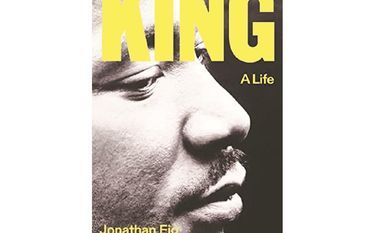
King Jr. was born in 1929. Were he alive he would be 94, the same age as Noam Chomsky. The prosperous King family lived on Auburn Avenue in Atlanta. One writer, quoted by Jonathan Eig in his supple, penetrating, heartstring-pulling and compulsively readable new biography, King: A Life, called it “the richest Negro street in the world.”
Eig’s is the first comprehensive biography of King in three decades. It draws on a landslide of recently released White House telephone transcripts, FBI documents, letters, oral histories and other material, and it supplants
David J Garrow’s 1986 biography Bearing the Cross as the definitive life of King, as Garrow himself deposed recently in The Spectator.
King and his two siblings had the trappings of middle-class life in Atlanta: Bicycles, a dog, allowances. But they were sickly aware of the racism that kept them out of most of the city’s parks and swimming pools, among other degradations.
King was bright and skipped several grades in school. He thought he might be a doctor or a lawyer; the high emotion in church embarrassed him.
When he arrived in 1944 at nearby Morehouse College, one of the most distinguished all-Black, all-male colleges in America, he was 15 and short for his age. He picked up the nickname Runt. He majored in sociology. He read Henry David Thoreau’s essay “Civil Disobedience” and it was a vital early influence. He began to think about life as a minister, and he practiced his sermons in front of a mirror.
He was small, but he was a natty dresser and possessed a trim moustache and a dazzling smile. Women were already throwing themselves at him, and they would never stop doing so.
He attended Crozer Theological Seminary in Pennsylvania, where he fell in love with and nearly married a white woman, but that would have ended any hope of becoming a minister in the South. Eig describes how several young women attended King’s graduation from Crozer and how each expected to be introduced to his parents as his fiancée.
King then pursued a doctorate at Boston University. In Boston he fell in love with Coretta Scott, he said, over the course of a single telephone call. She had attended Antioch College in Ohio and was studying voice at the New England Conservatory; she hoped to become a concert singer. They were married in Alabama, at the Scott family’s home near Marion. They spent the first night of their marriage in the guest bedroom of a funeral parlour, because no local hotel would accommodate them.
The Kings moved to Montgomery, Alabama, in 1954, when he took over as pastor at the Dexter Avenue Baptist Church. A year later, a seamstress named Rosa Parks refused to give up her seat to white passengers on a Montgomery bus. Thus began the Montgomery bus boycott, an action that established the city as a crucible of the civil rights movement. The young pastor was about to rise to a great occasion, and to step into history.
“As I watched them,” he wrote about the men and women who participated in the long and difficult boycott, “I knew that there is nothing more majestic than the determined courage of individuals willing to suffer and sacrifice for their freedom and dignity.”
By the time we’ve reached Montgomery, King’s reputation has been flyspecked. Eig flies low over his penchant for plagiarism, in academic papers and elsewhere. (King was a synthesizer of ideas, not an original scholar.) His womanizing only got worse over the years. This is a very human, and quite humane, portrait.
Many readers will be familiar with what follows: The long fight in Montgomery, in which the world came to realize that this wasn’t merely about bus seats, and it wasn’t merely Montgomery’s problem. Later came the 1963 March on Washington and King’s partly improvised “I Have a Dream” speech.
During these years, King was imprisoned on 29 separate occasions. He never got used to it. He had shotguns fired into his family’s house. Bombs were found on his porch. Crosses were burned on his lawn. He was punched in the face more than once. In 1958, in Harlem, he was stabbed in the chest with a seven-inch letter opener.
King’s relationships with John F Kennedy and Robert Kennedy were complicated; his relationship with Johnson was even more so. King and Johnson were driven apart when King began to speak out against the Vietnam War, which Johnson considered a betrayal.
The details about Hoover’s relentless pursuit of King, via wiretaps and other methods, are repulsive. American law enforcement was more interested in tarring King with whatever they could dig up than in protecting him. Hoover tried to paint him as a communist; he wasn’t one.
Eig lingers on the cadences of King’s speeches, explaining how he learned to work his audience, to stretch and rouse them at the same time. He had the best material on his side, and he knew it. Eig puts it this way: “Here was a man building a reform movement on the most American of pillars: The Bible, the Declaration of Independence, the American dream.”
Eig’s book is worthy of its subject.
©2023 The New York Times News Service

 "The content of a character")


 Connect with us on WhatsApp