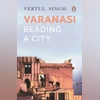
Banaras: A Journey into the Heart of the City
Author: Vertul Singh
Publisher: Penguin Random House India
Pages: 372
Price: Rs 699
Every time I visit Banaras, I leave with a wish to return to its warm embrace. The superficial reason is that there is so much to see that one lifetime is just not enough. The deeper reason is a thirst for an opportunity to experience stillness amidst the chaos of a city that seems as ancient as beginningless time. The calming presence of the river Ganga has a mysterious pull not only for worshippers but also for those who seek nourishment in the lap of nature.
This back story of my relationship with the place should tell you why I was excited to read Banaras: A Journey into the Heart of the City, a book by Vertul Singh who has worked for the Indian Army, served a spokesperson for the United Nations Police in Kosovo, and been on deputation to the Ministry of Home Affairs. Not only did it meet my expectations, it surpassed them. It taught me things that a tourist or pilgrim might never know; only Banarasis would because the city is their home, not just a destination to flaunt on Instagram reels.
Mr Singh tells us, for instance, that “the traditional Banarasi breakfast of kachori-and-jalebi undergoes a seasonal metamorphosis”. In the winter, jalebi is served with hot milk. In the summer, it is served with curd. Moreover, the “stuffing in the kachori may change from moong or urad to fresh sweet green peas”. In this age when everything is available at any time, thanks to advancement in technology, this adherence to a seasonal cycle might appear dated but it is also a reminder of how things seemed more precious when we had to wait.
The author also describes traditions that seem delightful to read about but might be dismissed as time-consuming by people who think about the physical labour involved rather than the nostalgia to be milked out of such memories. He recalls how, a day before Holi, “bodies were scrubbed by a very Banarasi ubtan paste…made from mustard seeds and Bengal gram flour, by grinding it on a grinding stone, to which a ladleful of fresh cream is added.”
The strongest parts of the book are those where the author dwells on his personal connection with Banaras. He writes about his father Vijaymohan Singh’s meeting with American poet Allen Ginsberg in October 1963. They were introduced by poet Trilochan Sastri. Ginsberg, who was accused of being a spy for the Central Intelligence Agency (CIA), used to rent a room at the Dashashwamedh Ghat in Banaras along with his partner Peter Orlovsky.
One of the most poignant descriptions in the book is about an elderly relative who used to visit the author’s ancestral house in Banaras every year during the winter months. She had been told by an astrologer that she would die in “the sheetkal months of Ashadh, Paush or Magh” so she timed her visits accordingly, hoping that she would attain liberation from the cycle of rebirth by taking her last breath in Banaras under the watch of Lord Shiva, who is also called Kashi Vishwanath. Her wish was fulfilled. She died after falling from a cycle rickshaw in Banaras. Onlookers said that her face had “a strange luminous glow”.
Though his affection for the city is unmistakable, the author does not wear rose-tinted glasses. He feels comfortable pointing out what disappoints and bothers him about his beloved city. He writes about ponds that have become dumping grounds, land that is being encroached upon by criminals, dolphins that are under threat because of water pollution, the dwindling population of ghariyals, and the psychedelic lights and laser beams on the ghats that have replaced the “flickering yellow wicks of the floating oil lamps” on the day of Dev Diwali.
The author also displays a familiarity with a large volume of earlier writings on Banaras. He draws from the Vedas, Puranas, Upanishads, and the Jataka Tales and also from more recent work—non-fiction, poetry, and fiction—written by people like Rahul Sankrityayan, Mirza Ghalib, Jawaharlal Nehru, James Prinsep, Hazari Prasad Dwivedi, Diana Eck, M A Sherring, Vasudev Saran Agrawal, Romila Thapar, Kubernath Sukul, Kashinath Singh, Sandria B Freitag, Vidula Jayaswal, Tony Joseph, Maaz Bin Bilal, Irfan Nabi, Nilosree Biswas, Abdul Bismillah, Hemant Sharma, Elizabeth-Chalier Visuvalingam and Sunthar Visuvalingam. His bibliography would serve as a useful reading list for others looking to write about Banaras.
The missing piece in this book is a more nuanced engagement with the religious diversity of the city. While he does acknowledge the presence of Jain temples, Buddhist sacred sites, mosques, gurudwaras, and churches, he devotes few pages to them and attributes this to space constraints. One hopes that a future edition of this book will compensate for this lack because one of the most alluring aspects of Banaras is its ability to accommodate differences.
The reviewer is a journalist, educator and cultural commentator. @chintanwriting on Instagram and X