By J Wortham WE TRIED TO TELL Y’ALL: Black Twitter and the Rise of Digital Counternarratives
Author: Meredith D Clark
Publisher: Oxford University Press
Pages: 174
Price: $24.99
Do you remember where you were in early December 2020? It was peak pandemic, so chances are you were at home and online. And if you were Black and on Twitter, you were probably reading or tweeting about the Negro Solstice.
On December 5, an argument about the authenticity of the coronavirus ended with a pandemic denier saying that for Black people, on the upcoming winter solstice, during this extraordinary planetary conjunction, “our Real DNA will be unlocked.”
The twinned cosmic events seemed star-crossed to a few other Twitter users, and what followed is what the chronically online like to call a “poster’s holiday.” Jokes flew among Black people about turning into the X-Men, levitating, acquiring powers and beaming themselves into the future. People uploaded selfies with photoshopped glowing laser eyes. Someone refashioned the logo from the 2006 show “Heroes” into “Negros.”
Meredith D Clark, a professor of race and political communication at the University of North Carolina at Chapel Hill, uses this example to kick off her new book, We Tried to Tell Y’All: Black Twitter and the Rise of Digital Counternarratives. She writes that the #NegroSolstice was a “life-affirming signal that Black people were somehow surviving a second year of lockdowns — and with our humor intact.”
It was undeniably one of the better chapters on late Twitter, yet few people outside the intended community knew what to make of it — if they knew about it at all. One person Clark interviewed for her book described Black Twitter as “a powerful, parallel Twitter,” and it often felt that way, like being in a kitchen at a party and having a completely different — and often more interesting — conversation than the main one going on in the living room.
Although it was all so chronologically recent — and although some denatured forms of it still exist — Clark noticed that young people around her seemed to be, already, forgetting the glory days of Black Twitter, and their importance. Clark memorialises Black Twitter, hoping to prevent further perversion of Black innovation, Black language, culture and style. (Just look at the complete and utter devolution of “woke.”)
Black Twitter’s most lasting legacy, according to Clark, is pulling off a “full-scale revolution” in how American news media reported on Black people — which she correctly argues has a direct correlation to how people perceive the value of Black life and govern it. She intends the book as a warning: To continue on in the tradition of white media elites will lead to a further disenfranchisement of nonwhite people (and working-class white people, too). Her warning has prescience: It’s here.
For a time, Black Twitter forced the world to pay attention to Black people and their concerns. Clark describes its contributions as “a collective intervention on mainstream media narratives about Black life in America in the early 21st century.”
She gives the example of the hashtag#IfTheyGunnedMeDown, created in response to the mainstream media’s use of discriminatory headlines and photographs of Michael Brown to construct a narrative of criminality after he was killed by Darren Wilson. Or the way Black Twitter compared the acquittal of Casey Anthony with the conviction of Shanesha Taylor, a young mother put in jail for leaving her kids in the car during a job interview. Each of these instances — and there are dozens, if not hundreds — lays bare the hypocrisy in our legal system and how it is normalised by unconscious journalistic biases.
Anyone who relied on Black Twitter as a source of relief and entertainment knows the community served as an antidote to the constant gaslighting that comes with living in America.
Clark excavates deeper: She doesn’t just ratify jokes and meme culture as collective processing. She frames the larger phenomenon as a necessary infrastructure of accountability that has been denied and would not be available any other way. Black Twitter exists for laughs, of course, but it also exists to resist the sane-washing of America (and the world) by constantly refuting the racist assumptions that underline Black existence in America and are often fortified by the media.
The book does not fully tangle with the cost of being in these spaces and doing this work publicly — the harassment and the data surveillance and mining whose tolls we cannot yet fully understand. Sure, people launched careers off their accounts, but we made less money than was made off us, and there are a number of uncanny and unnerving similarities to all of the predominantly white industries — sports, music, Hollywood — that have extorted and extracted value from Black creatives since the beginning of time.
Also, by omitting most of the ways Black Twitter occasionally cannibalised itself, Clark chooses to focus on a collective goodness of Black culture online — as if everyone shares the same goals of social justice, or even the definition of liberation.
Clark finished her book before the blast ratio of Elon Musk’s takeover of the site could be fully comprehended, but the same question lingers over her formidable body of work. What does the future hold? That’s for a different book.
Black Twitter has waned, but it is far from over. The conditions that created the need for Black Twitter have not dissipated; if anything, they are only intensifying. What Clark carefully and lovingly outlines is too necessary not to repeat itself. It was a rare moment in history to be in control of the narratives created about us. And at least for now, there’s a blueprint to know how to start again when the time is right.
The reviewer is a staff writer for The Times Magazine and co-editor (with Kimberly Drew) of the anthology Black Futures
©2025 The New York Times News Service

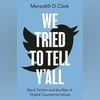 "'We Tried to Tell Y'All': Meredith D Clark chronicles rise of Black Twitter")


