Budget 2018: From GDP to inflation, which fares better - Modi govt or UPA?

The NDA government was able to control inflation more efficiently than the UPA government, aided by soft commodity prices. However, it could not accelerate economic growth by much

Budget 2018, Arun Jaitley
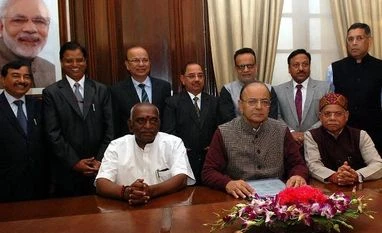
Finance Minister Arun Jaitley with MOS For Finance P Radhkrishnan', MOS For Finance Shiv Pratap Shukla, and with the full Budget Team while giving final touches to the Union Budget 2018-19 in New Delhi. Photo: Dalip Kumar
Indivjal Dhasmana New Delhi
Last Updated : Feb 01 2018 | 10:02 AM IST
Finance Minister Arun Jaitley will present the fifth and last full Budget of the Narendra Modi-led government's first term on Thursday. He is the first finance minister in National Democratic Alliance (NDA) governments to present all five Union Budgets in a term. In the previous NDA government, headed by A B Vajpayee, the then finance minister Yashwant Sinha was replaced by Jaswant Singh in 2002.
 
Call it sheer luck of soft commodity prices or better management, the National Democratic Alliance (NDA) government was able to control inflation much more efficiently than the legacy handed down by the UPA government.
 
However, it could not accelerate economic growth much. UPA had left with economic growth of 6.4 per cent in 2013-14 and NDA accelerated it to 6.5 % in 2017-18, if advance estimates come correct. The range of 7-7.5% for 2018-19 is projection only. The culprit for slow growth was demonetisation and goods and services tax (GST) as the economic growth had really picked up in the first two years of the Modi government.
 
GST also slowed down projection for tax revenues growth for 2017-18 compared to the previous year, but it was still higher than where the UPA government left. The government better managed its expenditure in the sense that while they slowed down growth in outlays, it was primarily on the revenue expenditure side despite pay hike for government employees in 2016-17. The NDA government paused on fiscal consolidation twice -- in 2015-16 and 2017-18. One has to wait for a few hours to see whether it will pause for 2018-19 as well and whether even bit of relaxed fiscal consolidation would be adhered to for 2017-18 or not.

Note: *Advance estimates in 2017-18, **Economic Survey’s projection, ***First half of FY18; BE: Budget Estimates Sources: Budget papers, Central Statistics Office, Controller General of Accounts, RBI, Economic Survey 2017-18

One subscription. Two world-class reads.

Already subscribed? Log in

Subscribe to read the full story →
*Subscribe to Business Standard digital and get complimentary access to The New York Times

Smart Quarterly

₹900

3 Months

₹300/Month

SAVE 25%

Smart Essential

₹2,700

1 Year

₹225/Month

SAVE 46%
*Complimentary New York Times access for the 2nd year will be given after 12 months

Super Saver

₹3,900

2 Years

₹162/Month

Subscribe

Renews automatically, cancel anytime

Here’s what’s included in our digital subscription plans

Exclusive premium stories online

  • Over 30 premium stories daily, handpicked by our editors

Complimentary Access to The New York Times

  • News, Games, Cooking, Audio, Wirecutter & The Athletic

Business Standard Epaper

  • Digital replica of our daily newspaper — with options to read, save, and share

Curated Newsletters

  • Insights on markets, finance, politics, tech, and more delivered to your inbox

Market Analysis & Investment Insights

  • In-depth market analysis & insights with access to The Smart Investor

Archives

  • Repository of articles and publications dating back to 1997

Ad-free Reading

  • Uninterrupted reading experience with no advertisements

Seamless Access Across All Devices

  • Access Business Standard across devices — mobile, tablet, or PC, via web or app

Next Story




