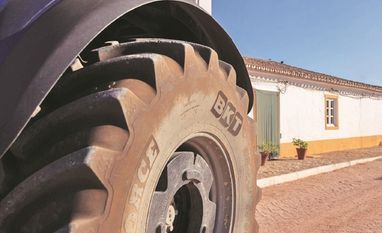
Balkrishna Industries is pivoting from its stronghold in the niche off-highway tyres (OHT) market to the crowded consumer tyre segment, betting that manufacturing scale and brand investment can lift group revenues to Rs 23,000 crore by FY30.
The company has allotted Rs 3,500 crore for the transition comprising new product lines, capacity expansion and brand-building initiatives that include a national campaign featuring actor Ranveer Singh. It marks BKT’s first serious attempt to build a domestic consumer franchise after decades of export-led growth in agriculture, mining and construction tyres.
BKT’s on-highway foray spans two-wheelers and medium and heavy commercial vehicles (M & HCVs), segments characterised by high volumes, intense price competition and entrenched competitors. The company said its strategy reflects growth ambitions and risk diversification amid shifting global trade patterns and uneven demand in some overseas markets.
Arvind Poddar, chairman and managing director (MD) of Balkrishna Industries, said the approach draws from the company’s earlier India playbook. “When we entered the Indian agricultural tyre market, it was overcrowded but we could not ignore India. We spent six to nine months studying what could work and developed something different,” he said.
Product engineering and route-to-market execution were the key differentiators. “Product development was one differentiator; distribution was the other. We were among the first to adopt a distributor-led model when everyone else was selling only through dealers,” he said, adding that this approach helped BKT scale to over 20 per cent share in India’s agricultural tyre market.
He said similar fundamentals underpin the consumer push. “India’s B2C mobility market — two-wheelers, passenger cars and commercial vehicles — is growing rapidly. Road infrastructure is improving, vehicle ownership is rising, and daily driving distances have increased significantly. This growth will inevitably flow through to tyres,” Poddar said. “Quality, distribution and market growth are the three pillars. Internally, we are targeting a five percent share by 2028–29.”
Rajiv Poddar, joint MD of the company, explained the growth math. “We have announced capex of about Rs 3,500 crore, largely directed towards B2C, which is a new vertical for us,” he said. “The investment is spread over three years. We are one year in, and the balance will be deployed over the next 15 to 18 months,” he said.
“BKT’s foray into the on-highway tyre segment is a strategic milestone under our Vision 2030 — an India-led initiative to scale responsibly and expand our mobility footprint. With a defined revenue roadmap of Rs 23,000 crore by 2030 — a 2.2x increase from FY25 levels — this measured growth is built on clarity, capability and long-term commitment,” said Rajiv Poddar.
The capacity backbone to support the plan is in place. BKT has a tyre manufacturing capacity of around 360,000 tonnes, with expansion under way at its Bhuj facility as part of the Rs 3,500-crore investment. The additional capacity will support both the core off-highway business and the new on-highway portfolio, including commercial vehicle radial tyres slated for launch in FY27.
Under Vision 2030, BKT expects around 20 per cent of revenue to come from on-highway tyres, while off-highway products will continue to contribute about 70 per cent, with carbon black accounting for the remainder. The company is also restructuring its brand architecture, creating two verticals — BKT Tyres and BKT Carbon — to separate its consumer ambitions from its industrial legacy. Management is targeting a 5 per cent market share in domestic on-highway segments by FY30.
Beyond Bhuj, BKT has largely completed a cycle of upgrades across its existing plants, focusing on automation and equipment modernisation. Management does not foresee another major expansion phase at non-Bhuj facilities for five to six years. The current investment cycle is expected to set up the on-highway and B2C business, complete planned expansions and begin delivering returns before the next capex phase is considered, while routine maintenance and productivity-linked capital expenditure continues as part of normal operations.
BKT’s success in consumer tyres will hinge less on engineering — its traditional strength — and more on execution: distribution depth, dealer alignment and sustained brand investment in a market where incumbents have spent decades building recall.

 "Balkrishna Ind enters consumer tyre market; eyes ₹23K cr topline by FY30")


