Samsung India, unions hold out amid output cut as strike enters Day 12

According to CITU, around 90 per cent of the total 1723 workers of the Sriperumbudur plant are participating in the strike
Samsung India
Shine Jacob Sriperumbudur
5 min read Last Updated : Sep 20 2024 | 11:37 PM IST
When Chennai residents were suffering due to the scorching heat over the past one week — with temperatures touching their highest ever (39 degrees Celsius) like in 1920 and 2002 — a group of workers continued their strike about 45 km away at the Samsung Electronics unit in Sriperumbudur.

The strike, backed by the Centre of Indian Trade Unions (Citu), started on September 9.

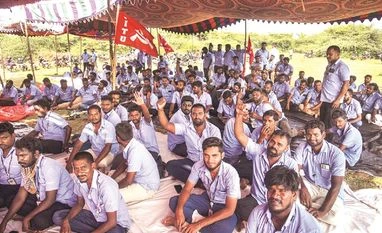
Employees were conducting their strike on tents at a vacant ground around 300 metres away from the plant’s main gate.

“No worker should speak to any media or YouTube channel. Only leaders and select representatives are allowed to speak,” a young man in his mid 20s announced on loudspeakers to around 500 people. Those inside the tent were in blue uniforms.

“We have only one demand, our Union should be recognised. The Samsung Management is reluctant to discuss and resolve issues with the majority Union, Citu,” A Jenitan, a senior Citu leader, told Business Standard.

After this, police detained around 118 striking workers on Monday, while they attempted to march to the district collector’s office.

This has captured widespread attention globally. It comes at a time when Tamil Nadu announced major investments to the tune of Rs 7,000 crore after chief minister M K Stalin's visit to the United States. The return of Ford Motor to Chennai was also on his agenda.


Strike hits production, says Citu

According to Citu, around 90 per cent of the total 1,723 workers of the Sriperumbudur plant are participating in the strike.

A company source said they are ready to talk to employees and not a third party like Citu.

“Citu means employees. Management is not ready to talk even on the 11th day,” Jenitan added.

The union reportedly claimed that there was a significant impact on production. Compressor production fell from 13,800 to 8,000 units per day and refrigerator production from 10,000 to 700 units per day. Washing machine production went down from 3,000 to 1,400 units a day.

This fall is happening ahead of the festival season. On the other hand, company sources said this claim is not correct and around 50 per cent of its employees are attending work.

“There is only minimal impact on production. Soon, production will be back to normal,” a company source said.

”This is not true, the plant is running for formality with only around 200 employees,” the Citu leader said.

So far, three meetings have happened with the deputy commissioner of labour, law minister, and labour secretary.

 
Denting industry sentiment

For some time, strikes were causing a major headache to the state, which was leading in electronics exports, owing to the China Plus One policy, mainly driven by Apple.

“This is causing huge damage for the state and the country. With Citu causing trouble at several units, companies investors will be in a spot. The state government is not taking any action to stop this strike,” said Tamil Nadu BJP vice-president Narayanan Thirupathy.

“This Samsung unit alone generates 30 per cent revenue (out of the total $12 billion) of Samsung’s business in the country. The home appliances industry is facing this hardship at the time of festivals,” he added.

In the first nine months of 2022-23, the state saw 2,178 industrial disputes, including the strikes at Ford, Yamaha India and INDO Tech and the state government had to intervene for a solution.

According to the Indian Labour Journal, 0.2 million person days were lost in India in 2023, with the highest being reported in Tamil Nadu.

Samsung workers in Seoul receive Rs 4.5-6 lakh on an average as wages and salaries per month while their Indian counterparts are working for a meagre Rs 20,000-25,000, according to Citu.

According to E Muthukumar, a state Citu leader and president of the Samsung India Workers Union, the workers should get an average salary of Rs 36,000, extended over a period of three years.

According to an industry body, the average salary will vary depending on whether it is an Indian or a foreign company and the scale of the firm.

“The average salary according to government rules in the area is around Rs 16,000. In addition to that, food and transportation are provided by companies,” said an industry body executive.

“We need a ban on mandatory overtime work on a regular basis, an eight-hour work schedule and pay parity for workers with equal experience,” Jenitan said.

Similar strikes were organised by Citu at Apple supplier Flex in 2023 and at the Foxconn unit in June this year (when reports of gender bias came out at Foxconn).

“We can sort this out. We will do it as soon as possible," state labour minister C V Ganesan told the media.

Despite this confidence, as days pass, the future of employees and the state's investor sentiment remain bleak.


One subscription. Two world-class reads.

Already subscribed? Log in

Subscribe to read the full story →
*Subscribe to Business Standard digital and get complimentary access to The New York Times

Smart Quarterly

₹900

3 Months

₹300/Month

SAVE 25%

Smart Essential

₹2,700

1 Year

₹225/Month

SAVE 46%
*Complimentary New York Times access for the 2nd year will be given after 12 months

Super Saver

₹3,900

2 Years

₹162/Month

Subscribe

Renews automatically, cancel anytime

Here’s what’s included in our digital subscription plans

Exclusive premium stories online

  • Over 30 premium stories daily, handpicked by our editors

Complimentary Access to The New York Times

  • News, Games, Cooking, Audio, Wirecutter & The Athletic

Business Standard Epaper

  • Digital replica of our daily newspaper — with options to read, save, and share

Curated Newsletters

  • Insights on markets, finance, politics, tech, and more delivered to your inbox

Market Analysis & Investment Insights

  • In-depth market analysis & insights with access to The Smart Investor

Archives

  • Repository of articles and publications dating back to 1997

Ad-free Reading

  • Uninterrupted reading experience with no advertisements

Seamless Access Across All Devices

  • Access Business Standard across devices — mobile, tablet, or PC, via web or app

Topics :ChennaiSino-Indian tradeAsian Paints

Next Story


