Dr Harsh Vardhan, Minister for Science & Technology and Earth Sciences, on April 22, 2016 inaugurated India’s first second-generation (2G) ethanol demonstration plant at Indian Glycols Ltd’s Kashipur facility in Uttarakhand.
The technology demonstration plant, with a capacity to consume 10 tonnes of biomass per day, is based on the globally-competitive indigenous technology of converting lingo-cellulosic biomass to ethanol. It is a feedstock-independent technology developed by DBT-ICT Centre for Energy Biosciences at the Institute of Chemical Technology (ICT) Mumbai, supported by Department of Biotechnology, Ministry of Science and Technology and the Biotechnology Industry Research Assistance Council (BIRAC).
Dr Harsh Vardhan said that it is a novel technology suited to both Indian & global needs and is projected to be capable of converting all types of agricultural residues like bagasse, rice straw, wheat straw, bamboo, cotton stalk, corn stover, wood chips, etc to ethanol in less than 24 hours, with optimum product yields. If successfully operated and scaled-up, it will establish India as a major global technology provider in the arena of renewables and reduction in carbon-emissions, besides effecting considerable savings in import of crude oil.
Government of India has set a mandate of 5 percent blending of renewable biofuel in both petrol and diesel. While diesel biofuel blending is near zero, the petrol blending today stands at an overall of about 3 percent in the form of first generation (1G) or molasses-based ethanol.
While the annual requirement of 1G-ethanol stands at about 500 crore litres, the current total installed capacity is about 265 crore litres. In such a scenario, the targets of 10 percent blending by 2017 and 20 percent by 2020 look remote unless agricultural waste based ethanol, ie 2G-ehanol production technologies are successfully demonstrated. India’s potential for 2G-ethanol production from a mere 10 percent of its non-food and non-fodder agricultural residues, currently estimated to be available in excess of 300 million tonnes, stands at nearly 1000 crore litres of ethanol.
Dr K Vijay Raghavan, Secretary, Department of Biotechnology, expressed confidence that this technology, with the lowest capital and operating costs, would allow 2G-alcohol to be produced and sold at globally competitive price. The DBT-ICT Centre has already developed designs of plants with capacities of 250-500 tonnes per day. He added, “This is an example of how we can work on the challenges the world faces, define them in Indian labs and then strive to solve them for the benefit of the world community in general and India in particular.”

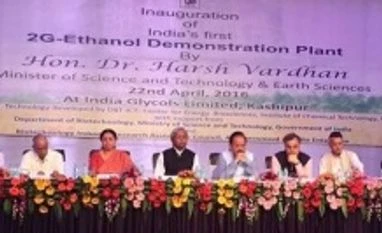 "Plant to make ethanol from cellulosic biomass inaugurated at Kashipur")


 Connect with us on WhatsApp