Home / Economy / News / EU seeks stronger commitment from India on reducing 'high' import tariffs
EU seeks stronger commitment from India on reducing 'high' import tariffs
The discussion on the FTA will signal the 'broader political commitment' from both leaders and set the stage for the 10 round of negotiation in Brussels during 10-14 March, after a six months hiatus
premium
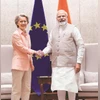
PM Narendra Modi and European Commission President Ursula von der Leyen will meet later this week to push forward trade deals FILE PHOTO
3 min read Last Updated : Feb 25 2025 | 11:45 PM IST
The European Union (EU) expects ‘stronger commitments’ from India on reducing ‘high’ import tariffs on cars, wines, and spirits as part of the ongoing negotiations for a free-trade agreement (FTA), a senior EU official said on Tuesday, ahead of the meeting of Prime Minister Narendra Modi and European Commission President Ursula von der Leyen later this week.
The discussion on the long-pending FTA and the investment pact are expected to signal the ‘broader political commitment’ from both leaders and set the stage for the 10th round of negotiations in Brussels from March 10-14, after a six-month hiatus.
Von der Leyen will be in New Delhi from February 27-28, accompanied by EU commissioners from 21 countries — the first such visit to India — as the trade bloc is keen to develop a “new strategic agenda” with India. The discussions will lay the groundwork for the India-EU summit, expected in the second half of the year.
The timing of the Modi-von der Leyen meeting is crucial, given the escalating trade war and reciprocal tariff threats from US President Donald Trump. Besides, the EU views India as an “alternative provider” of key goods, which is in line with its diversification and de-risking agenda regarding China, the official said.
Apart from the trade agreement, the EU will also raise concerns about the “effectiveness and enforcement” of the bloc’s sanctions against Russia.
Other key areas will include India’s role in the Ukraine peace process, shared concerns over China, the India-Middle East-Europe Corridor (IMEC), and artificial intelligence (AI), a senior EU official said on Tuesday.
“India is certainly a very important partner to pursue an agenda that we’ve called – de-risking, building resilience, diversifying our trade, imports, and investment. India, in our view, is becoming a very interesting destination for investment. A lot of large investors, including Apple in the technology side, are choosing India as a destination for manufacturing and investment,” the official said.
There could be some progress in the FTA discussions on Friday, although no major announcement is expected immediately.
While the EU understands that India maintains high import tariffs due to its status as a large emerging economy with developmental challenges, it stresses the need to address tariff asymmetry.
India currently imposes a 150 per cent import duty on wine and tariffs ranging from 70-100 per cent on cars.
“Indian tariffs, on an average, are much higher than those maintained by the EU or US…not just at tariffs, we have several but non-tariff barriers, regulatory barriers. There are many restrictions for the people on spirits, procurement side at the level of the states. So those are certainly some of the issues that we will continue to raise,” official said.
Priority list
> Concerns on effectiveness of sanctions against Russia
> India’s role in Ukraine peace talks
> EU believes India is a potential alternative to China in trade and investment
> Progress on IMEC will be significant topic of discussion
In context
> FTA talks will set the stage for negotiations in Brussels (March 10-14) after six months
> Discussions to pave way for India-EU summit later in the year