The government is planning to significantly ramp up the radiation processing of onions to create a buffer stock of 1,00,000 tonnes this year, as it aims to prevent shortages and price rises of the politically sensitive bulb, according to a top government official.
The world's biggest exporter of onions is expected to see output fall by 16 per cent to 25.47 million tonnes in 2023-24 amid lower yields in key growing states of Maharashtra, Karnataka and Andhra Pradesh, according to government estimates.
To discourage hoarding and curb price volatility often sparked by supply disruptions, the government plans to use radiation technology on a large scale to increase onions' shelf life, said Nidhi Khare, secretary at the consumer affairs ministry.
"We are identifying 50 irradiation centres around the consuming areas. If we are successful, we will be able to store up to 1 lakh tonnes of radiation-processed onions this year," Khare told PTI.
The ministry has asked the state agencies NAFED and NCCF, who are procuring 500,000 tonnes of onions to create a buffer stock this year, to explore irradiation facilities around key consumption centres such as Sonepat, Thane, Nasik and Mumbai.
Radiation processing was tried on a small scale of 1,200 tonnes near the growing region of Maharashtra last year.
To facilitate quicker transportation of the buffer stock, the ministry is also considering setting up controlled atmosphere storage facilities at major railway hubs, Khare added.
In the past, the government has banned onion exports and stockpiled a substantial share of the crop to safeguard supplies after hoarding and drought cycles led to shortages.
(Only the headline and picture of this report may have been reworked by the Business Standard staff; the rest of the content is auto-generated from a syndicated feed.)

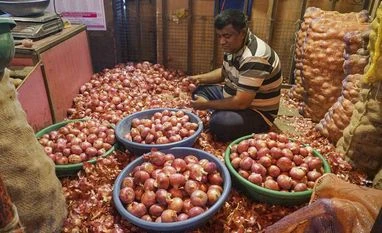 "Govt plans large scale radiation processing of onions to prevent shortages")


