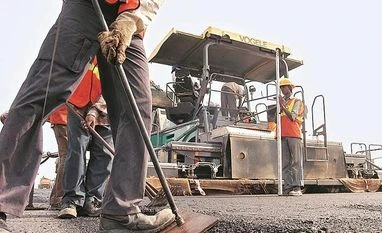
The government’s pace of awarding contracts to build roads has slowed down in Financial Year 2023-24 (FY24), but it is still far better than its first five years from 2010 to 2014.
In eleven months of 2024, the implementing agencies of the road transport and highways ministry had awarded road projects of 3720.72 km . The length is almost 24 per cent less than the pace achieved in FY23. When dates for general elections are announced in a few weeks, all new awards will stop and the ministry will be hard put to match the annual average of 4,477 km road contracts awarded between FY20 and FY23.
Nitin Gadkari, Minister for Road Transport and Highways (MORTH), told Parliament in February he is aware of the shortfall. “The ministry has urged all the implementing agencies to improve their progress in awarding of contracts by fast tracking the process of fulfilment of conditions” needed to get the sanctions, he said.
Road construction and contracts matter for the economy. Sectors ranging from steel, cement, power, transport and labour employment depend on the work schedule for roads, particularly the national highways.
When the government says capital investment has increased 34 per cent year-on-year in FY23, it was primarily roads which its managers had in mind. In a ten-year period, the national highway network has increased from 91,287 km in March 2014 to 146,145 km now. The length of four-lane plus national highways, including high-speed corridors, has increased from 18,371 km in March 2014 to about 46,179 km.
The average pace of road construction between FY19 and FY23 was about 30 km per day. For the earlier four-year period, FY15 to FY18 it was 20 km per day. In FY24, the pace has come down to 28 km per day. There are two key reasons for this: The reduced financial space of the National Highways Authority of India (NHAI), which has cut its new borrowings, and the focus on building expressways. For building expressways, MORTH has changed the bidding structure that is more dependent on the finances of the bidders and less on government handouts.
As many as 25 expressways spanning 9,125 km are being built under the ministry’s Bharatmala Pariyojana. Including five yet to be awarded, all of them have been built as super speed access controlled highways. The projects include the showpiece Delhi-Mumbai Expressway of 1,386 km. The Bharatmala Pariyojana was launched in 2017 to build 34,800 km of highways at the cost of Rs 5.35 trillion by 2022. The latest reply by the ministry in Parliament shows those estimates have approximately doubled to Rs 10.97 trillion.
After the Finance Ministry has rejected proposals to expand funding for highways construction, an inter-ministerial committee was set up to consider amendments to clauses on tolling during construction period, changing the definition of debt due as well as modification in concession period for variation in actual traffic in comparison to target traffic (for details please see attached box). This change of gear has come at the cost of speed in constructing roads.
The amendments were inevitable as the financial space for NHAI to borrow has come down. In the four heady years when the pace of road building shot up, NHAI borrowed a sum of Rs 2.77 trillion. As the debt overhang threatened NHAI’s financial viability, the government stopped all its borrowings. NHAI raised only Rs 798 crore as Internal and Extra Budgetary Resource in FY23 and nil in FY24.
NHAI, a financial and semi-regulatory institution, is expected to compensate for borrowings with monetisation of the road assets, but the pace of the task has been slow. The ball park figure is that the assets should be generating returns of at least Rs 5 crore per km. There are broadly three types of ways NHAI could earn revenue from its road assets. These are a) Infrastructure Investment Trusts or InvIT, b) Toll Operate Transfer(TOT) and c) project specific SPV. Toll collections generate revenue to finance one or other of these projects.
Till December 2023, the total sum generated by Infrastructure Investment Trusts or InvIT has been only Rs 10,200 crore for eight projects bundled into two packages. From TOT the earnings (actual and projected) have been Rs 32,949.6 crore. There has been one SPV, the Delhi Mumbai Expressway monetised at Rs 33,876 crore. (see Box 2)
Because of the dissonance between borrowing and the receipts, the NHAI bag now holds 167 pending road projects. MORTH ascribes various reasons for why they are there, ranging from delays in land acquisition, tree cutting, utility shifting, unseasonal rainfall, local agitation, forest clearance and even the impact of Covid-19. The short of it is, there has been an increase in the cost of these projects ßpossibly making many of them unviable. Not surprisingly in the government’s Vivad Se Vishwas scheme, meant to offer a speedy closure of arbitral cases, the ministry has the highest number of applications other than the tax department, at 120. The data is up to February 2024. The last date for the receipt of applications under the scheme is 31, March, 2024.
India’s road network increased from 54,02,486 km in March 2014 to 63,31,791 km in March 2019, making it the second largest in the world. When a new government takes charge in some months, building on this record will involve clearing cobwebs.