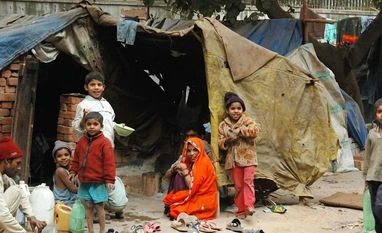
The year 2019-21 represents the years when the economy slowed down, first due to pre-coronavirus factors and then due to coronavirus-induced lockdowns. The economy grew eight per cent in 2015-16, but the growth came down to 3.9 per cent in 2019-20 and contracted 5.8 per cent in 2020-21.
Not only the multidimensional poverty, based on the National Family Health Surveys (NFHS), declined from 24.85 per cent during 2015-16 in the country, as many as 13 of 36 states and union territories had less than five per cent of their population in multidimensional poverty in 2019-21 against eight in 2015-16. As many as 135 million people exited multidimensional poverty over this period.
The multidimensional poverty index (MPI) measures poverty on the basis of parameters such as nutrition, child and adolescent mortality, maternal health, years of schooling, school attendance, cooking fuel, sanitation, drinking water, housing, electricity, assets, and bank accounts.
Experts raised questions about some of these parameters and point out that the index is so structured that multidimensional poverty will never rise over a period unless there is natural devastation such as earthquakes or extreme floods.
C Rangarajan, former chairman of the Prime Minister's Economic Advisory Council, said it is very difficult to figure out whether the parameters taken in MPI really represent the extent of well-being of the people.
"For example, MPI also takes into account bank accounts. Bank accounts do not indicate the welfare of the people. Obviously, bank accounts will keep increasing over a period. Therefore, it needs to be discussed how relevant are some of these indicators," Rangarajan, who headed a committee to estimate poverty in 2009-10 and 2011-12 as compared to 2004-05 after an earlier committee's poverty line drew flak from various quarters.
He also said the mortality rate changes only over a long period. "Therefore, it (parameters like mortality rate) does raise a question mark. It does raise some doubts," he said.
Rangarajan recalled that his panel's report also used a combination of indicators, which was a mix of multiple indicators and household consumption expenditure. Both the measures showed a sharp decline in poverty between 2004-05 and 2011-12, a period of "maximum rate of growth of the economy", he said.
The committee had estimated that 29.5 per cent of the population in India was poor in 2011-12. According to the earlier Tendulkar Committee, there were 37.2 per cent of the population in poverty during 2004-05. This declined to 29.8 per cent in 2009-10 and 21.9 per cent in 2011-12, according to the Tendulkar Committee report. The Rangarajan committee had measured that 38.2 percent of the population was in poverty in 2009-10.
The Rangarajan panel's estimates were based on certain normative standards of food and non-food consumption as well as behavioural aspects of classes concerned with the consumption of some other items. On the basis of that, the panel said a person spending less than Rs 1,407 a month (Rs 47 a day) in 2011-12 should be considered poor in cities as against the Tendulkar panel's suggestion of Rs 1,000 a month (Rs 33 a day). Similarly, a person spending Rs 972 a month (Rs 32 a day) should be considered poor in villages against the Tendulkar committee's suggestion of Rs 816 a month (Rs 27 a day).
Rangarajan said 2004-05 to 2011-12 was a period of maximum rate of growth of the economy. "I needed both indicators to understand what is happening in the economy," he said.
He said 2019-21 was not a good year to calculate the poverty estimates because that included the Covid-19-affected year.
The economy grew 6.9 on average during 2005-06 to 2011-12, while it expanded by just 3.9 per cent during 2016-17 to 2020-21, according to the new series of gross domestic product (GDP) calculations on the 2011-12 base year.
NITI Aayog does not use the poverty line but NFHS surveys to build MPI. Besides, there is no household consumption expenditure survey after 2011-12 to come out with poverty lines.
NFHS was planned in two phases with an initial reference period of 2019-20. The survey work was carried out between July-December 2019. The survey work for the second phase started in January, 2020 but was affected by coronavirus-induced lockdowns as it was halted for eight months during March-November. However, the survey work was completed in April, 2021, thus changing the reference period to 2019-21.
Pronab Sen, head of the committee that is reviewing official statistics, said MPI does not indicate the current economic status of people, it is a measure of deprivation to help the government help them.
"The way MPI is structured it is almost impossible that it will show a decrease in these indicators over a period of time unless there is a catastrophe such as an earthquake etc. On the other hand, poverty in the current income status can go up and down over a period of time," he pointed out.
He said earlier too the government used multidimensional indicators to benefit the vulnerable section. He cited the example of issuance of the below poverty line cards in the early part of the previous decade which were based on socio-economic caste censure, a kind of multidimensional indicator only.
Anil K Sood, professor, and co-founder of The Institute for Advanced Studies in Complex Choices, said MPI was initially positioned as a descendant of the Human Development Index and was expected to supplement income-based single measures. "It is indeed a supplement, but a supplement that measures poverty only in its extreme form. That is, it is at best a measure of acute poverty," he said.
The progress that India is making is in reaching the minimum threshold on an acute poverty measure, Sood said. Even then, according to Oxford Poverty and Human Development Initiative (OPHI), the original MPI designer, and UNDP's Human Development Report Office (HDRO) database, India had 230 million people who are MPI poor, and 60 million of them are classified to be in severe poverty in 2019-21, he said.
He said indicators such as bank accounts are more a result of the government's choice of providing direct benefit transfer (DBT) rather than an individual’s need for accumulating their savings in banks or doing transactions through banks.
"I would, therefore, argue that we must not refer to MPI as a measure of poverty. It is, at best, a measure of acute poverty. We have a long way to go before we can start providing for even the basic needs," Sood said.
At the same time, the number of people vulnerable to poverty has gone up from 253 million in 2015-16 to 263 million in 2019-21, the data showed.
The MPI takes into account bank accounts, which do not indicate welfare. Bank accounts will keep increasing over a period. Therefore, it needs to be discussed how relevant some of these indicators are
C Rangarajan, former chairman, PMEAC
MPI does not indicate the current economic status of the people. It is a measure of deprivation to help the government to help them. The way the MPI is structured, it is almost impossible that it will show a decrease in these indicators over a period of time ...
Pronab Sen, Former chief statistician
One subscription. Two world-class reads.
Already subscribed? Log in
Subscribe to read the full story →
Smart Quarterly
₹900
3 Months
₹300/Month
Smart Essential
₹2,700
1 Year
₹225/Month
Super Saver
₹3,900
2 Years
₹162/Month
Renews automatically, cancel anytime
Here’s what’s included in our digital subscription plans
Exclusive premium stories online
Over 30 premium stories daily, handpicked by our editors


Complimentary Access to The New York Times
News, Games, Cooking, Audio, Wirecutter & The Athletic
Business Standard Epaper
Digital replica of our daily newspaper — with options to read, save, and share


Curated Newsletters
Insights on markets, finance, politics, tech, and more delivered to your inbox
Market Analysis & Investment Insights
In-depth market analysis & insights with access to The Smart Investor


Archives
Repository of articles and publications dating back to 1997
Ad-free Reading
Uninterrupted reading experience with no advertisements


Seamless Access Across All Devices
Access Business Standard across devices — mobile, tablet, or PC, via web or app
)