4 min read Last Updated : May 21 2025 | 1:23 PM IST
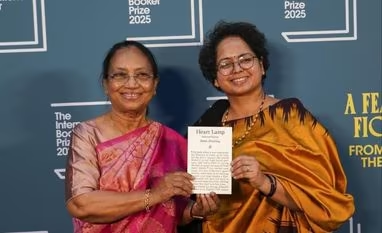
Banu Mushtaq, a 77-year-old author, lawyer, activist and fearless voice for women and the marginalised, has made literary history. She became the first Kannada writer to win the International Booker Prize, sharing the prestigious honour with her translator Deepa Bhasthi for the short story collection Heart Lamp.
The award, which includes a £50,000 prize, marks a series of firsts—the first time a Kannada work has received the accolade and the first short story collection to win the International Booker.
“This feels like a thousand fireflies lighting a single sky – brief, brilliant and utterly collective,” Mushtaq said. “I accept this great honour not as an individual but as a voice raised in chorus with so many others.”
What is Banu Mushtaq's Heart Lamp and why it won the Booker Prize
“My stories are about women—how religion, society and politics demand unquestioning obedience from them, and in doing so, inflict inhumane cruelty upon them,” Mushtaq told The Booker Prize.
The judges praised Heart Lamp for its “immense emotional and moral weight” and for giving voice to women on the margins.
How Banu Mushtaq’s upbringing shaped her literary voice
Mushtaq’s literary journey began in middle school, and her first story was published at age 26 in Prajamata, a Kannada magazine. Though Urdu was her first language, her progressive father enrolled her in a convent school. Kannada became her chosen language of resistance.
In interviews with Vogue and The Week, she described being pushed into domesticity after her love marriage, battling postpartum depression, and surviving a suicide attempt.
“Once, in a fit of despair, I poured white petrol on myself… intending to set myself on fire,” she said. Her husband intervened and begged her not to abandon their child. That moment, she said, brought her back from the brink.
Banu Mushtaq: A fearless activist beyond the literary world
Mushtaq has long been an outspoken advocate for women’s rights and social justice. She served as a journalist for over a decade and held two terms on the Hassan City municipal council. Her activism has drawn threats and violence—including a knife attack and a fatwa after she supported women’s right to pray in mosques.
Her writing has been shaped by Karnataka’s progressive movements in the 1970s and 1980s, including the Dalit, environmental, and women’s rights struggles.
“The pain, suffering and helpless lives of these women create a deep emotional response within me, compelling me to write,” she said.
Other works by Banu Mushtaq and her literary recognition
In addition to Heart Lamp, Banu Mushtaq has authored:
Six short story collections
One novel
One essay collection
One poetry collection
Notable titles include Haseena Matthu Ithara Kathegalu (2013) and Hennu Haddina Swayamvara (2023). She has received the Karnataka Sahitya Academy Award and the Daana Chintamani Attimabbe Award.
Her work has been translated into Urdu, Hindi, Tamil and Malayalam, but Heart Lamp is her first full-length translation into English. Her short story Kari Nagaragalu was adapted into the National Award-winning film Hasina (2004), directed by Girish Kasaravalli.
Who is Deepa Bhasthi, the translator of Heart Lamp?
Deepa Bhasthi is a writer and translator based in Karnataka's Kodagu. According to the Booker Prize Foundation, she works across literature, art, and cultural research. Her translation of Heart Lamp is the first full-length English translation of Banu Mushtaq’s work. The Booker Prize profile states that she is currently based in India and works on a range of cultural and literary projects.

 "Who is Banu Mushtaq, first Kannada author to win International Booker?")

