Group Captain Shubhanshu Shukla’s successful completion of Axiom Mission 4, along with his and the Gaganyaan crew’s space-flight training in Russia, has validated India’s crew-screening and selection process for its planned first human spaceflight mission, Assistant Chief of the Air Staff (Medical) Air Vice-Marshal Anupam Agarwal revealed on Sunday, a day after the country celebrated the second National Space Day.
“There are numerous medical and physical parameters that must be considered when selecting the crew for a manned space flight,” said Air Vice-Marshal Agarwal, explaining that since Gaganyaan marked the Indian Space Research Organisation’s (Isro’s) maiden attempt, there was no pre-existing data or benchmarks to rely on. “When the Gaganyaan programme was approved in December 2018 to undertake human spaceflight to Low Earth Orbit (LEO) and establish the foundation for technologies required for an Indian human space-exploration programme, we had very little time to develop the procedure for crew selection and screening entirely from scratch. The Institute of Aerospace Medicine rendered yeoman service in this effort, as no country was willing to share the required information in this domain,” he added.
Highlighting that the four selected Gaganyatris — Group Captains Shukla, P B Nair, Ajit Krishnan, and Angad Pratap — were also evaluated by the Russians before their training there, and that Group Captain Shukla underwent additional screening in the United States (US) as part of the Axiom Mission 4, Air Vice-Marshal Agarwal explained that these multiple rounds of evaluation validated the selection procedure and processes independently established by India.
As part of the four-person Axiom-4 mission, Group Captain Shukla became the first Indian ever to set foot on the International Space Station (ISS) and only the second Indian to travel to space. After successfully completing his 18-day mission aboard the ISS, he returned to Earth on July 15. Axiom-4, a commercial mission operated by the Houston-based private firm Axiom Space, was a collaboration between the US space agency, National Aeronautics and Space Administration (Nasa), Isro, the European Space Agency, and Elon Musk’s SpaceX.
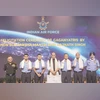
Also on Sunday, Defence Minister Rajnath Singh felicitated Group Captains Shukla, Nair, Krishnan, and Pratap during an event in the national capital. Speaking on the occasion, Singh praised the four Gaganyatris, describing them as “gems of the country” and pioneers embodying the nation’s aspirations.
Highlighting the expanding presence of India in space, Singh added: “We do not see space only as a field of research, but as the future of tomorrow’s economy, security, energy, and humanity. We are steadily advancing beyond the Earth’s surface into new frontiers of space. We have already marked our presence from the Moon to Mars, and today, the nation stands fully prepared for missions like Gaganyaan.”
Commending Group Captain Shukla for his successful space mission, Singh emphasised the officer’s determination and courage, adding these qualities reflected the spirit of India. “Completing two and a half year’s training in just two and a half months, he showcased his personal dedication and the perseverance of the Indian people. His extraordinary feat is not just a technological achievement, but a message of faith and dedication. It is not just India’s pride, it is proof of the progress of entire humanity,” the defence minister said.
Calling Group Captain Shukla a symbol of “civil-military fusion”, the defence minister added: “Though he wears the uniform of the Indian Air Force (IAF), his journey into space was not merely on behalf of the armed forces or India alone, but as a representative of all humanity. His contribution to the civil sector, through this historic mission, will forever be recorded in history.”
The Gaganyaan programme has recently entered its final phase, with the first human spaceflight now scheduled for the first quarter of 2027. The test mission schedule remains on track and will culminate in India’s maiden human spaceflight, launching Indian Gaganyatris (astronauts) into orbit aboard an Indian rocket from Indian soil.
As of May, the Human-rated LVM3 vehicle, the Crew Escape System, and the Crew Module and Service Module were all in final stages of testing and integration. Four IAF pilots, selected as Gaganyatri-designates, have completed training in Russia and are now undergoing further mission-specific training in India. Their health, psychological fitness, and simulation-based operational readiness continue to be assessed at India’s dedicated astronaut training facility.
The Gaganyaan Programme has a financial outlay of about ₹20,193 crore. Prime Minister Narendra Modi has also outlined India’s long-term ambitions in space, which include establishing the Bharatiya Antariksha Station by 2035 and sending the first Indian to the Moon by 2040.


 "Axiom-4 proves Gaganyaan crew selection standards are among world's best")

