To further strengthen India–Mongolia defence ties, New Delhi on Tuesday announced that it will post a defence attaché in Ulaanbaatar and launch a new capacity-building programme for Mongolia’s border security forces.
India and Mongolia signed 10 agreements, including one on geological exploration, following talks between Prime Minister (PM) Narendra Modi and visiting Mongolian President Khurelsukh Ukhnaa. The PM described India as a “steadfast” and “reliable partner” in Mongolia’s development and announced that New Delhi will provide free e-visas to Mongolian citizens to strengthen people-to-people contacts.
Officials said the two delegations discussed Indian companies prospecting for oil in Mongolia, the exploration of critical minerals, and the import of coking coal for India’s steel industry. Mongolia has reserves of copper, gold, iron, and zinc. It has also discovered uranium reserves, for which it has signed a $1.6 billion deal with a French mining company. India has conveyed its interest in importing uranium, officials added.
However, the route for shipments of minerals and other produce to India is still being worked out, as Mongolia is a landlocked country. New Delhi is considering two alternatives — China’s Tianjin port and Russia’s Vladivostok port. The latter is seen as a more workable option despite higher costs, given New Delhi–Moscow ties. Officials observed that Russia offers discounts for trading via Vladivostok.
India and Mongolia are marking 70 years of diplomatic ties and 10 years of a strategic partnership, which was signed during Modi’s visit to Ulaanbaatar in 2015.
Addressing a joint briefing, the PM spoke about the oil refinery project supported by India’s $1.7 billion line of credit to Mongolia, which will strengthen its energy security. “It is India’s largest development partnership project globally, with over 2,500 Indian professionals working alongside their Mongolian counterparts to make it a reality,” he said.
Later, at a media briefing, Ministry of External Affairs Secretary (East) Periasamy Kumaran said it was a “longstanding” request from Mongolia that India post a resident defence attaché at its embassy in Ulaanbaatar. He added that the oil refinery project is expected to be completed by 2028.
Defence Minister Rajnath Singh also met the Mongolian President, who arrived in India on Monday for a four-day state visit. India conducts the ‘Nomadic Elephant’ military exercise with Mongolia — the latest edition took place in June this year — provides equipment, and has helped set up a cybersecurity training centre for its military, which is slated for an upgrade.
The two countries are exploring ways to increase bilateral trade, with Mongolia seeking Indian expertise to boost its wool exports. They also discussed the viability of bilateral air services, with Mongolia proposing chartered flights to India operated by one of its carriers.
Modi underscored India’s cooperation in skill development for Mongolia’s youth. “I am happy that our private sector is also exploring new possibilities of cooperation in areas such as energy, critical minerals, rare earths, digital, mining, agriculture, dairy, and cooperatives,” he said. The PM added that India and Mongolia “stand as close partners in international fora, supporting a free, open, inclusive, and rules-based Indo-Pacific”.
In his speech, the Mongolian President praised India’s leading role in the clean energy sector and specifically referred to the New Delhi-led International Solar Alliance (ISA). Mongolia is likely to become a signatory to the ISA.
In his media statement, Modi said India and Mongolia “share the age-old bond of Buddhism, which is why we are also called spiritual siblings”. He announced, “Next year, the holy relics of two great disciples of Lord Buddha — Sariputra and Maudgalyayana — will be sent from India to Mongolia.”
“The memorandum of understanding signed on Tuesday between the Ladakh Autonomous Hill Development Council and Mongolia's Arkhangai Province will give a fresh boost to our cultural ties,” he added.

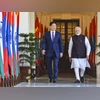 "India expands Mongolia footprint with defence attache, energy cooperation")


 Connect with us on WhatsApp