Israel used GPS spoofing against Iran: Did US do it to India in Kargil war?
Ahead of Iran's first-ever direct attack on Israel, Israeli intelligence reportedly jammed the country's GPS navigation system signals to confuse Tehran's missile targeting teams
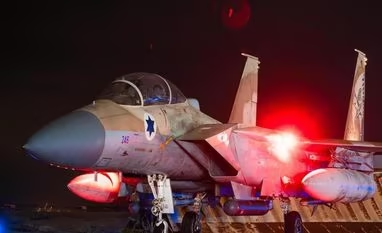
An Israeli Air Force plane returns to base after intercepting threats launched against Israel by Iran on April 14, 2024. Image Credit: @IAFsite (Official handle on X)
India's past military operations may have been hindered by the United States (US) using a technique similar to the one reportedly used by Israel to confuse Iran's missile targeting teams by jamming Global Positioning System (GPS) navigation signals in the days leading up to Tehran's overnight attack on Saturday.
Degrading, scrambling or jamming data provided by GPS, the space-based navigation system maintained by the US government, over a region can hinder the adversary's military operations and the accuracy of its missiles and drones, which often use a combination of GPS, inertial guidance and terrain contour matching to accurately navigate to their programmed target.
Ahead of Iran's first-ever direct attack on Israel on Saturday night, Israeli intelligence jammed GPS navigation system signals within their territory to confuse Tehran's missile targeting teams, reported the Daily Mirror, a British national daily tabloid newspaper.
About 25 years ago, when Pakistani soldiers crossed into India and took positions in Kargil in 1999, the Indian military had sought GPS data for the region, only to be denied by the US, according to a report by an Indian national daily.
As explained by a 2021 United States Naval Institute article, the US Department of Defense and Air Force initially employed a technology called "selective availability", which would introduce intentional errors into civilian GPS receivers. This ensured that the best accuracy was retained exclusively for military use.
The article went on to explain that the US used this technology to "degrade" GPS accuracy for the Indian military during the Kargil war, which "hindered Indian operations". Eventually, such actions by the US led India and others to develop their own navigation systems.
India went on to build an independent, stand-alone satellite navigation system called NavIC (Navigation with Indian Constellation), developed by the Indian Space Research Organisation (ISRO). NavIC provides precise and secure positioning, navigation, and timing services anywhere in India and 1500 kilometres beyond India's territorial boundary. NavIC offers standard positioning services for civilian purposes and restricted services for strategic needs.
Coming back to the present, the Daily Mirror report said that ahead of the Iranian attack, which was long expected, Israeli locals found that their GPS showed them to be in Cairo (Egypt) or Beirut (Lebanon). It added that the resulting confusion was meant to throw Iran's missiles off target.
Almost all of the more than 300 drones and ballistic and cruise missiles Iran launched at Israel on Saturday night failed to hit their targets, with 99 per cent of the projectiles being downed as Israel, the US, the United Kingdom (UK) and Jordan intercepted them before they got to Israel.
Only "a small number" of ballistic missiles reached Israel, but did not cause any loss of life.
The Iranian projectiles were intercepted by US, British, Jordanian and Israeli combat aircraft, the US Navy's Aegis missile defence system, and Israel's multi-layered missile defence.
In total, about 170 drones, 30 cruise missiles and 120 ballistic missiles were launched at Israel by Iran overnight on Saturday.
The Daily Mirror report added that Iran's ballistic missiles and drones, which can be guided using GPS, were equipped with Russia's GLONASS system to bypass Israel's jamming.
However, the GLONASS system, which is an alternative navigation tool to the GPS, is less accurate.
The report added that Iran may have been able to bypass Israel's GPS signal jamming attempts to some extent.


 "Israel used GPS spoofing against Iran: Did US do it to India in Kargil war?")


