
US NSA Jake Sullivan's visit to India postponed for second time this year
'Due to ongoing events in the Middle East, NSA Sullivan has postponed his trip to India this week,' a US embassy spokesperson said
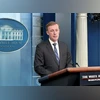 "US NSA Jake Sullivan's visit to India postponed for second time this year")
WebinarsNew
Deep DiveNew
Explore Business Standard
'Due to ongoing events in the Middle East, NSA Sullivan has postponed his trip to India this week,' a US embassy spokesperson said
US National Security Advisor Jake Sullivan has postponed his visit to India this week in view of the evolving situation in West Asia following escalating hostilities between Israel and Iran.
It was the second time this year that Sullivan deferred his trip to India.
The senior Biden administration official was scheduled to hold wide-ranging talks with his Indian counterpart Ajit Doval on the progress in implementation of the US-India Initiative on Critical and Emerging Technologies (iCET), besides other issues.
"Due to ongoing events in the Middle East, NSA Sullivan has postponed his trip to India this week," a US embassy spokesperson said.
West Asia has been reeling under increasing tensions after Iran carried out the first direct attack on Israel by firing hundreds of drones and missiles early Sunday.
Iran carried out the attack on Israel in response to a suspected Israeli strike on its consulate in Damascus on April 1 that killed seven Iranian Islamic Revolutionary Guards including a senior general.
"NSA Sullivan looks forward to holding the iCET annual review at the next earliest possible date and remains personally committed to advancing our deeply consequential and multifaceted partnership with India," the spokesperson said.
The visit was earlier planned for February. It was called off that time because of Sullivan's pressing commitments.
In his comments, the US embassy spokesperson also mentioned that President Joe Biden is looking forward to the next meeting of Quad leaders.
"Similarly, the President looks forward to the next meeting of the Quad leaders and continuing our efforts with India to deliver results for the American and Indian people, as well as our partners, in support of our shared vision for a free, open, and prosperous Indo-Pacific," he said.
The Quad leaders' summit was planned in India in January. However, it could not take place as Washington conveyed to India that Biden would not be able to travel.
The spokesperson said US President Biden too looks forward to the next meeting of Quad leaders.
Sullivan and Doval were expected to review overall progress in implementation of the ambitious iCET initiative.
A key aspect of Indo-US engagement has been collaboration in specific high-technology areas including semiconductors, next-generation telecommunication, artificial intelligence and defence under the iCET.
(Only the headline and picture of this report may have been reworked by the Business Standard staff; the rest of the content is auto-generated from a syndicated feed.)
First Published: Apr 16 2024 | 10:11 PM IST

