Operation Sindoor showcased national air defence capability: Govt sources

India's air defence grid countered the multi-domain threat posed by Pakistan, ranging from hard-to-detect drones to high-speed missiles
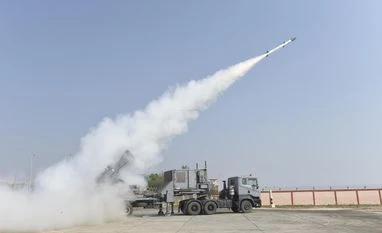
Operation Sindoor showcased national air defence capability: Govt sources
The air defence (AD) capability of the Indian Armed Forces is achieved by seamless networking, integration and automation of all its AD resources, which are distributed across the three services
Bhaswar Kumar New Delhi
3 min read Last Updated : May 15 2025 | 12:52 AM IST
Indians witnessed the operational demonstration of the country’s integrated national air defence capability during the almost four-day-long Operation Sindoor, government sources said on Wednesday, adding that these capabilities were demonstrated during some of the most intense exchanges in the air and missile defence domain.
 
Indian forces successfully neutralised Pakistani attack in the wake of the May 7 strikes on terrorist camps in response to the April 22 Pahalgam terrorist attack.
 
“What made it challenging was the multi-domain nature of the threat, which ranged from slow-speed, low radar cross-section (RCS) drones to high-speed projectiles launched from stand-off distances,” explained the sources, adding, “These threats simultaneously targeted the entire expanse of the western borders from Kutch in Gujarat to Srinagar and Awantipur in Jammu and Kashmir (J&K).”
 
The air defence (AD) capability of the Indian Armed Forces is achieved by seamless networking, integration and automation of all its AD resources, which are distributed across the three services.
 
“The requisite AD capability is assured through a system of sensors and weapon systems that are located in a tiered and layered architecture, networked through robust, resilient, secure and redundant communication systems, and integrated through a state-of-the-art command and control system,” the sources said, adding that this brings to the commander a transparent battlefield picture, with real-time decision-making capabilities. 
 
Stating that the general public witnessed the integrated response of India’s national AD grid in real time, which thwarted Pakistan’s offensive strategy, the sources underscored that with India possessing one of the fastest-growing civil aviation sectors, ensuring the safety of civil airlines during this high-intensity conflict was a fundamental responsibility.
 
“This was undertaken through extensive coordination with the Ministry of Civil Aviation and its entities—the Airports Authority of India and the Directorate General of Civil Aviation,” they added.
 
The country’s airspace was defended through the Indian Air Force’s (IAF’s) Integrated Air Command and Control System (IACCS), with the Army’s air defence grid (Akashteer) and the Navy’s Integrated Maritime Situational Awareness System (IMSAS) grid also integrated with it. This tri-services integration gives a “National Air Space Management” capability to the military leadership, said the sources. While India’s air defence is the overall responsibility of the IAF, the other two services also play a vital role with their sensors and firing units.
 
They also underlined that all these systems—the IACCS, Akashteer, and the IMSAS—are indigenously designed and developed by the country’s aerospace industry, and are a reflection of its state-of-the-art technical capability. 
Pakistan’s AD systems appear to have been less effective. Stating that India’s offensive strikes targeted key Pakistani airbases — Noor Khan and Rahim Yar Khan — with surgical precision, a Wednesday PIB release said: “All strikes were executed without loss of Indian assets, underscoring the effectiveness of our surveillance, planning, and delivery systems.”
 

One subscription. Two world-class reads.

Already subscribed? Log in

Subscribe to read the full story →
*Subscribe to Business Standard digital and get complimentary access to The New York Times

Smart Quarterly

₹900

3 Months

₹300/Month

SAVE 25%

Smart Essential

₹2,700

1 Year

₹225/Month

SAVE 46%
*Complimentary New York Times access for the 2nd year will be given after 12 months

Super Saver

₹3,900

2 Years

₹162/Month

Subscribe

Renews automatically, cancel anytime

Here’s what’s included in our digital subscription plans

Exclusive premium stories online

  • Over 30 premium stories daily, handpicked by our editors

Complimentary Access to The New York Times

  • News, Games, Cooking, Audio, Wirecutter & The Athletic

Business Standard Epaper

  • Digital replica of our daily newspaper — with options to read, save, and share

Curated Newsletters

  • Insights on markets, finance, politics, tech, and more delivered to your inbox

Market Analysis & Investment Insights

  • In-depth market analysis & insights with access to The Smart Investor

Archives

  • Repository of articles and publications dating back to 1997

Ad-free Reading

  • Uninterrupted reading experience with no advertisements

Seamless Access Across All Devices

  • Access Business Standard across devices — mobile, tablet, or PC, via web or app

Topics :Indian Air ForceOperation SindoorDefence newsIndia-Pakistan conflict

Next Story



