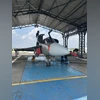
Air-to-air and air-to-ground weapons firing trials, along with software fixes, have been completed on the advanced variant of India’s indigenous fighter jet, the Light Combat Aircraft (LCA) Tejas Mark-1A (Mk1A), and are awaiting certification, a source at state-run Hindustan Aeronautics Limited (HAL) said on Thursday. This comes as the company stated that “five aircraft are fully ready for delivery”.
In October, HAL officials had said deliveries of the Mk1A to the Indian Air Force (IAF) would begin by the end of financial year 2026 (FY26).
“The weapons firing trials for the indigenous Astra beyond-visual-range air-to-air missile, the British ASRAAM missile for close-range combat, and laser-guided bombs for ground attack have been completed. The pending software patches have also been completed. Both are now pending certification,” the source said on the condition of anonymity.
The Centre for Military Airworthiness & Certification, a regulatory body under the Defence Research and Development Organisation, carries out airworthiness certification of military aircraft and airborne systems.
Earlier in the day, an official release by the defence public sector undertaking said, “… Five aircraft (Mk1A) are fully ready for delivery, incorporating major contracted capabilities in accordance with the agreed specifications.” An additional nine aircraft have already been built and flown, and will be made ready for delivery once their F404-IN20 engines are received from American manufacturer GE Aerospace, it added.
HAL has received five engines from GE as of date. “The supply position from GE is positive, and the future delivery outlook aligns with HAL’s delivery plans,” it said.
All design and development issues identified are being addressed in an “expedited manner”, and the company is in “active discussions with the IAF to deliver the aircraft at the earliest”, HAL said.
This comes even as sources say HAL has been unable to meet the criteria to qualify as the development-cum-production partner for the country’s first stealth fighter jet, the Advanced Medium Combat Aircraft (AMCA). Competition for the AMCA programme will now likely be among three other shortlisted entities — the Tata Group and two consortiums led by Larsen & Toubro (L&T) and the Kalyani Group — though a final decision is yet to be taken, they added. Both the L&T- and Kalyani-led consortiums also include defence public sector undertakings.
Responding to media reports on developments in the AMCA programme, HAL said it had not received any official communication regarding it, and was not in a position to comment on the reports. “HAL would like to reiterate that it has a robust confirmed order book, providing strong revenue visibility, and a healthy production and execution pipeline extending up to 2032,” it said.
HAL missed the original February 2024 deadline to begin Mk1A deliveries, primarily due to delays in the arrival of engines from GE. At present, at least nine of the Mk1A jets built by HAL are fitted with reserve engines as an interim measure.
Deliveries of the first tranche of 83 Mk1A jets — contracted for ₹36,400 crore in February 2021 — were originally scheduled to be completed by February 2028.
In September, HAL received a follow-on order for a second tranche comprising 97 Mk1A aircraft — including 68 single-seat fighters and 29 twin-seat trainers — at a cost exceeding ₹62,370 crore. Deliveries under this contract are expected to commence in 2027-28, and conclude over six years.
The IAF, meanwhile, has operationalised two squadrons of the earlier Tejas Mk1 variant. However, two Mk1 trainer aircraft that were to be part of these squadrons are still pending delivery. The improved Mk1A variant is an indigenously designed, developed, and manufactured 4.5-generation fighter aircraft equipped with an active electronically scanned array radar, beyond-visual-range missiles, an electronic warfare suite, and air-to-air refuelling capability.
The retirement of the last two MiG-21 Bison squadrons in September 2025 has reduced the IAF’s combat strength to 29 active fighter squadrons — the lowest level in 60 years — against a sanctioned strength of 42. This has left the force searching for options to shore up its numbers, particularly as it has yet to receive a single Tejas Mk1A aircraft.

 "Tejas Mk1A completes weapons trials; five jets ready for delivery to IAF")


 Connect with us on WhatsApp