Climate change is real and so is its impact on human lives. With 80,000 lives lost and economic damages of around $180 billion between 1993 and 2025, India ranks sixth in the world in climate vulnerability, according to the Germanwatch Global Climate Risk Index 2025.
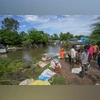
The impact of climate change is borne by people through the loss of their lives, and even if they somehow escape those life-threatening events, their capital and properties succumb to the disasters.
To solve this problem, the government is drafting a climate-linked insurance scheme. The scheme could help someone in Uttarakhand or Punjab whose house was washed away in the floods, or someone in Rajasthan whose business was affected due to heatwaves.
Let’s unfold the climate-linked insurance scheme and understand how it can help people:
What is a climate-linked insurance scheme?
As the climate-linked insurance scheme is in the early stage of drafting, there is no significant information provided by the government. However, according to a Reuters report, the climate-linked insurance policy will adopt a parametric insurance model.
What are the features of a climate-linked insurance scheme?
The climate-linked insurance scheme has many features such as:
a) It makes the payout fast and easy as it eliminates the need for assessment of the damaged areas.
b) It is more beneficial in areas vulnerable to climate change.
What is a parametric insurance model?
The parametric insurance model, also known as the index-based model, is a type of insurance that provides payment to the insured on the occurrence of a certain event or breach of a predetermined threshold, rather than covering or determining the actual loss.
For example, if the agreement says that an earthquake of 7.0 magnitude occurs in Haryana’s Gurugram district, then the insured person will get the payout if the event occurs, irrespective of the actual loss he or she faces.
Similarly, the agreement could say that in Rajasthan’s Churu district, if the temperature breaches 50 degrees Celsius, the insured person will get the payout upon the occurrence of the event.
How is the climate-linked insurance scheme helpful?
The parametric insurance model used in climate-linked insurance schemes is generally adopted keeping in mind the significance for the insured person. It is designed in such a way that it aligns with the risk to the business or assets of the client.
For example, Uttarkashi district of Uttarakhand is considered a hotspot for flood-related events that almost every year damage the assets and properties of people living and doing business in that area.
The climate-linked insurance scheme could be helpful to people running businesses in Uttarkashi as it covers occurrences of such events.
Another feature of the parametric insurance model is that it makes payouts easy and fast because it eliminates the need for assessment of the damaged area. This can significantly benefit clients, as assessments in traditional insurance policies can take years, leading to delays in payout and harming clients who need urgent capital.
What other countries have climate-linked insurance schemes?
With the rollout of the climate-linked insurance scheme, India will become the first major economy to introduce such a scheme. However, the climate-linked insurance scheme is already on the rise. In 2021, Fiji became the first Pacific nation to introduce the climate-linked insurance policy.
What is the model of Fiji’s climate-linked insurance scheme?
The model of the climate-linked insurance scheme adopted in Fiji is also a parametric insurance model launched by the country’s Minister for Economy, Aiyaz Sayed-Khaiyum. The country offers two insurance products to its people. The basic features of the products are:
a) The products provide coverage for 12 months.
b) The payouts are admissible after one month of the policy commencement.
c) Multiple events are covered under one policy year (to a maximum of 100 per cent of the sum insured).
d) Ease of payments through digital transactions using MPaisa and MyCash wallets.
The Fiji Climate Change Portal states that the insurance products were developed by the Pacific Insurance and Climate Insurance Programme (PICAP) under the United Nations Capital Development Fund (UNCDF), in conjunction with the United Nations Development Programme (UNDP) and the United Nations University – Institute for Environment and Human Security (UNU–EHS).
Why is there a need for the climate-linked insurance scheme in India?
As India is the most populated country in the world, any policy change will directly impact a large number of people.
On the other hand, climate change is significantly affecting the country, as the World Bank states, “India is already experiencing a warming climate.” And it’s not only warmer days; there are changing rainfall patterns, an increase in droughts, depleting groundwater resources, melting glaciers, and migration of people from disaster-affected areas.
“We’ve seen the frequency and severity of adverse climate events go up, and based on that, this discussion with the government also started,” Ramaswamy Narayanan, chairperson of state-run reinsurer GIC Re, told Reuters.
Most property and casualty executives say insurers are falling behind on climate adaptation. In ZestyAI’s 2025 State of Property Insurance report, 61% of the more than 220 executives surveyed said the industry isn’t responding fast enough to climate risks.
What is climate change?
Climate change is the long-term shift in the weather conditions and temperatures of the planet. The changes can be naturally driven, such as by the activities of the Sun. However, the United Nations states that since the 1800s, human activities such as the burning of fossil fuels like coal, oil, and gas are mainly responsible for climate change.
Who discovered climate change?
The exact answer to that question would be no one, because there is no single scientist or single discovery but a series of breakthroughs.
1800s: Eunice Foote demonstrated that carbon dioxide traps heat, today known as the greenhouse effect.
1938: Guy Callendar proved that global temperatures are rising.
1958: Dr Charles David Keeling provided the first evidence that CO₂ levels are rising.
1967: Scientists created the first computer model of Earth’s climate.
1968: Dr John Mercer warned that melting ice caps could lead to a disastrous rise in sea levels.
1969: For the first time, Earth’s temperature was measured with satellites.
1985: Scientists discovered that a hole had appeared in the ozone layer above Antarctica.
1992: Scientists realised that higher levels of CO₂ in the ocean would make it harder for corals and other animals to build reefs.
>Wallace Broecker
However, the term “climate change” was first used in its current sense by American geochemist Wallace Broecker in 1975 in his article titled “Climatic Change: Are We on the Brink of a Pronounced
Global Warming?”
How does climate change happen?
To understand the process of climate change, there are two terms that need to be understood: the ozone layer and greenhouse gases.
Ozone layer: There are five major layers in Earth’s atmosphere — the troposphere, stratosphere, mesosphere, thermosphere, and exosphere — but the most significant layer is the stratosphere because it contains the ozone layer, which protects the surface of the Earth from high temperatures and harmful ultraviolet rays of the Sun.
Greenhouse gases: There are various important gases in Earth’s atmosphere other than just oxygen. Key
greenhouse gases include carbon dioxide, methane, nitrous oxide, and others. The presence of greenhouse gases is vital for life to sustain on Earth, as they keep the temperature at an optimal level rather than at the freezing point of -18 degrees Celsius.
However, with the increase in human activities, greenhouse gases have risen beyond the required level, leading to depletion of the ozone layer — a major cause of climate change.
What human activities cause climate change?
The major human activities that cause climate change are deforestation, burning of fossil fuels, pollution of the air, water, and soil, overfishing, intensive agriculture, urbanisation, and waste disposal.
How does climate change affect humans?
“Climate change is directly contributing to humanitarian emergencies,” the
World Health Organization (WHO) stated, adding that climate change is increasing the scale, frequency, and intensity of heatwaves, wildfires, floods, tropical storms, and hurricanes.
According to WHO, climate change is expected to cause approximately 250,000 additional deaths per year from undernutrition, malaria, diarrhoea, and heat stress alone between 2030 and 2050.
WHO, in a report, estimates the direct damage costs to health will reach approximately $2–4 billion per year by 2030. The report also reveals that around 3.6 billion people live in areas that are highly susceptible to climate change.
Which places are most affected by climate change?
The places most affected by climate change are those with weak health infrastructure — mainly developing nations.

 "Climate-linked insurance scheme: Why govt is exploring it and what's ahead")


 Connect with us on WhatsApp