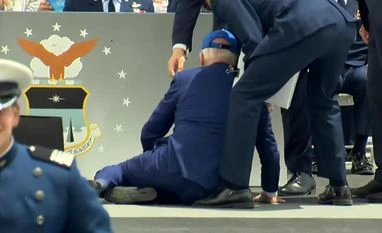
US President Joe Biden is "fine" after tripping and falling over at an event in Colorado, news reports said quoting White House officials.
Biden, who is USA's oldest serving president at 80, was helped back onto his feet and appeared to be unhurt after Thursday's fall. "I got sandbagged!" he joked to reporters later.
The news about Biden should draw attention to injurious or fatal falls, particularly among the elderly. WHO estimates there are some 684,000 fatal falls occur each year, making it the second leading cause of unintentional injury after road traffic mishaps.
“According to statistics, about 14 per cent to 53 per cent fatal and non-fatal injuries in the elderly (above the age of 65) are due to falls, with the associated mortality standing at as high as 86 per cent. Although falls are a common occurrence in the elderly, it is their associated complications that can make matters worse. Recovery from falling also becomes difficult after a certain age,” says Dr Vishal Sehgal, president of Portea Medical, a homecare services company.
Who is at risk
It is incorrect to believe that falls are a common side effect of old age and cannot be prevented, say doctors.
"The landscape of fall prevention for senior citizens [people older than 60 are likely to suffer fall injuries] has witnessed a remarkable breakthrough," says Dr Varun Gupta, chief business officer at Antara Assisted Care Private Limited.
“By monitoring key elements integral to fall risk, including physiological trends, gait analysis, sleeping patterns, and historical data, tech stack can offer a remarkably accurate and dynamic evaluation of an individual's vulnerability to falls,” he says.
Medical professionals specialising in falls cite two primary reasons: at the level of the individual and in spaces they live.
While all people are at risk of injury, the age and health of an individual can affect the type and severity of injury caused in a fall. Older people have the highest risk of death or serious injury. Dr Meinal Chaudhry, director for radiodiagnosis and intervention radiology at Aakash Healthcare Super Speciality Hospital in Delhi, explained how a fall injures a person.
“Sarcopenia, or weak muscles, especially in the legs leads to falls. As we age, we lose muscle mass which routinely starts from the lower body upwards. Muscle strengthening exercises help a lot to slow down Sarcopenia. Gait abnormalities, or unsteady walk, can arise due to loss of muscle strength or due to uncoordinated gait in various neural disorders like Parkinsonism or cerebellar dysplasia,” she says.
Blackouts are the biggest cause of falls in the bathroom, for young adults as well as the elderly. After a fall, a person should sit for 2-3 minutes and then get up slowly.
"Foot problems including pain and deformities can lead to unstable gait and falls. Conditions like flatfoot/ clubfoot or neuropathy caused by diabetes can lead to falls. Addressing the underlying condition like physiotherapy and right shoes for flatfoot, surgical correction of clubfoot and good sugar control and physiotherapy can help the patients.
"Vision problems in kids, adults or elderly can lead to recurrent falls. The predominant causes in different age groups can be different–like refractive errors in kids and adults and glaucoma and cataract in elderly. Congenital blindness or cataract can also present with fall in children,” says Chaudhry.
People who suffer from panic attacks, anxiety, or depression are at risk of falls as they could sometimes be distracted. People who take sleep medicines, anti-psychotic drugs, or antidepressant drugs are at risk, too. Substance abuse or drug withdrawal can cause disorientation and lack of coordination.
Retirement communities for the elderly don’t have uneven flooring, slippery floors, or furniture that can cause people to trip over. It is a design concept that can be replicated in homes. “Structural changes can be made to reduce the risk of falls. For example, installing the right flooring in high-risk areas like sports areas and adding grab rails in common areas like lobbies, especially in toilets, can provide additional support,” says Ankur Gupta, joint managing director of Ashiana Housing Limited.
"The first step is to identify the common causes of falls. To prevent such incidents, it is important to ensure proper lighting in the home and other accessible areas. Installing night lamps can also help, as seniors may be more prone to falls when getting up during the night. Evening lighting also plays a crucial role in fall prevention. Marking potential dangers with reflective black and yellow tape can improve visibility and reduce the risk of falls,” he says.
Safe at home
Sehgal, of Portea Medical, listed measures that can prevent falls and injuries at home.
The elderly should take their medication at the prescribed times. Skipping medication can weaken a person. It is important for the elderly to get enough physical activity.
Maintain cleanliness at home and avoid clutter. Stacks of old newspapers, magazines or other items should be kept aside.
Fix loose rugs or anything else that may seem off the place at home.
Install grab bars or handrails in the staircase, washroom, or any other place where the elderly may be vulnerable
Install bright lights, especially in stairways and hallways and nightlights in the bedroom.
Ensure that non-slip mats are placed in the kitchen and bathrooms, as these are the most accident-prone areas.
Caregivers should be trained in identifying potential fall risks, assisting with mobility, and providing a safe environment. Regular communication with healthcare professionals can help caregivers stay informed about best practices.
Having a balanced diet and taking calcium supplements from a young age boosts bone density and strength, thus enabling faster recovery from the effects of falling- fractures, cracks in bones, sprains, etc. Medical conditions such as osteoporosis, balance disorders, and certain medications can increase the risk of falling. Conducting regular health check-ups, managing chronic conditions, keeping track of blood pressure and sugar levels, and adjusting medications can significantly mitigate these risks.
| Risk factor | Consultation price |
| | |
Person’s Risk Assessment Review with Healthcare Professional (exercise and medication review with the doctor, vision checks, shoe assessment etc) | A consult costs Rs 700-1,500 |
| Space Assessment Review with Design Expert (home safety review) | A consult costs Rs 2,500- 3,500 |
| Grab Bars | Rs 4,990-6,290 |
| Anti Slip Shower Mat 40 x 60 | Rs 499-1,499 |
| Laser Lights | Rs 549-1,500 |
Source: market Research