
Scientists identify antibody 'SC27' to counter all Covid-19 variants
Researchers have discovered an antibody that could counter all known variants of the coronavirus that causes COVID-19 and also distantly related ones that infect other animals.
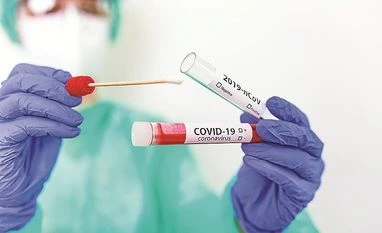 "Scientists identify antibody 'SC27' to counter all Covid-19 variants")
WebinarsNew
Deep DiveNew
Explore Business Standard
Researchers have discovered an antibody that could counter all known variants of the coronavirus that causes COVID-19 and also distantly related ones that infect other animals.
Researchers have discovered an antibody that could counter all known variants of the coronavirus that causes COVID-19 and also distantly related ones that infect other animals.
SARS-CoV-2, the coronavirus causing COVID-19, uses its spike protein to invade and infect another individual, or the host. Antibodies, produced by the host in response, bind to the spike protein to block its action and prevent infection.
The researchers, led by those at The University of Texas in Austin, US, isolated the antibody 'SC27' from the plasma donated by four patients. These patients had breakthrough infections, which occur when a vaccinated individual gets infected.
The research has been published in the journal Cell Reports Medicine.
Over the more than four years since the first case of COVID-19 emerged, SARS-CoV-2 has evolved to acquire certain characteristics which make the virus resistant to vaccines and treatments.
The authors said the 'SC27' antibody recognised all these various characteristics of the spike proteins across COVID-19 variants.
"One goal of this research, and vaccinology in general, is to work toward a universal vaccine that can generate antibodies and create an immune response with broad protection to a rapidly mutating virus," said one of the lead authors William Voss, a PhD graduate in cell and molecular biology at The University of Texas.
However, the authors also acknowledged that "the small number of individuals analysed may limit the interpretation of the data and leave it unclear how common the SC27-like antibody might be in human populations."
The researchers used the technology IgG proteomics, or 'Ig-Seq', to study hybrid immunity, which is one's antibody response to both infection and vaccination.
"The discovery of SC27, and other antibodies like it in the future, will help us better protect the population against current and future COVID-19 variants," study author Jason Lavinder from The University of Texas.
The researchers also found that hybrid immunity offered an increased protection against the disease, compared with infection or vaccination alone.
(Only the headline and picture of this report may have been reworked by the Business Standard staff; the rest of the content is auto-generated from a syndicated feed.)
First Published: Sep 09 2024 | 2:59 PM IST


 Connect with us on WhatsApp