Clearing the air: 2 out of 3 app-based cabs may go off road in Delhi

More than 130,000 app-based cabs ply on Delhi's roads daily, according to industry estimates
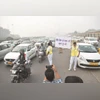
odd even, pollution
Surajeet Das Gupta New Delhi
4 min read Last Updated : Nov 09 2023 | 11:00 PM IST
Nearly two-thirds of app-based taxis may have to stop operating in the national capital if the Delhi government pays heed to the Supreme Court suggestion of barring entry of such vehicles registered in other states.
 
The apex court on Tuesday made the recommendation as a measure to curb the menace of air pollution in Delhi; on Thur­sday, ride-hailing aggregator Uber wrote a letter in protest against the suggestion.
 
More than 130,000 app-based cabs ply on Delhi’s roads daily, according to industry estimates. A vast majority of the vehi­cles run on compressed natural gas (CNG) and a miniscule percentage are electric.
 
“An indiscriminate restriction on CNG vehicles, which run on clean fuel, will force people to move to petrol or diesel vehicles,” said Uber India in a strongly-worded letter to the transport commissioner of Delhi government and to the lieutenant governor. The company has over 70,000 taxis in Delhi on its platform.
 
It pointed out that apart from having negligible impact on emissions, such a move would cause huge inconvenience to the public. This, it added, would be akin to a “mobility lockdown for citizens of Delhi-NCR (National Capital Region) who will be left in the lurch if they need access to critical infrastructure in Delhi like airport, railways stations and major hospitals”.
 
A senior executive of an app-based taxi service company with presence across the country said: The impact of such a measure will be massive on taxi app platforms in Delhi. Nearly two-thirds of electric cars or those powered by CNG will go off the roads as a bulk of the car owners are in Gurugram and Faridabad on the outskirts of Delhi.”
 
App-based vehicles run either on CNG or electricity, which are cleaner fuels than petrol or diesel, the executive said, adding that their removal would not have any positive impact on curbing pollution.
 
However, most app-based taxis support the odd-even scheme, although the Supreme Court has called it mere “optics”. Senior advocate Aparajita Singh, who is assisting the court as amicus curiae on the matter, has submitted that seeking to impose restrictions on the basis of “odd-even” numbers is an unscientific method.
 
Nonetheless, the Delhi government announced that it would enforce the scheme from November 13.
 
App-based taxis said that the scheme was not applicable on CNG and electric vehicles, so it did not impact their drivers. Secondly, they had expected the government to encourage less polluting vehicles by incentivising (CNG-run) idle ones to come on board with a waiver of the Rs 100 fee levied on commercial vehicles to enter Delhi.
 
A 2016 report by the Delhi government, in association with the Energy Policy Institute at the University of Chicago and Center for International Development at Harvard University, on the impact of odd and even numbered cars plying on alternate days had concluded that concentrations of PM 2.5 were reduced by 10-13 per cent on an average. There was also an additional 10 per cent reduction in emissions between 8 am and 8 pm, though air quality levels after 7 pm remained relatively unaffected.
It had also responded to a common argument that vehicles account for 25 per cent of Delhi’ s air pollution, of which only a small percentage is due to cars, and hence reducing the number cars on the road to half would not make a substantial difference.
 
The report explained that the odd-even scheme reduces pollution in two ways. First, there are fewer cars on the roads so some polluting sources are directly removed. A less understood second factor is that less congestion reduces the number of idling engines and slow-moving traffic across the city. And this, too, reduces pollution. The report added that the second factor may have been a major reason for reduced pollution and should be further investigated.
 
Singh, however, has suggested to the court an alternative step to control vehicular pollution — the introduction of colour-coded stickers. There should be blue stickers for petrol and CNG vehicles and orange ones for diesel vehicles that can be restricted or banned, she has sought. The Supreme Court has asked the Delhi government to respond to the proposal.

Clearing the air
  • Over 130,000 app-based taxis ply on Delhi roads every day
     
  • Two-thirds of them will be off the road if the state government agrees to Supreme Court (SC) suggestion to permit only those with Delhi registration in the city
     
  • App-based taxis support odd-even scheme, as it doesn’t hurt CNG and electric vehicles
     
  • Delhi govt study in 2016 showed substantial reduction in pollution due to odd-even scheme
     
  • Delhi govt will reinforce odd-even from Nov 13
     
  • SC has asked Delhi govt to respond to a proposal on colour-coded sticker-based curbs on vehicles

One subscription. Two world-class reads.

Already subscribed? Log in

Subscribe to read the full story →
*Subscribe to Business Standard digital and get complimentary access to The New York Times

Smart Quarterly

₹900

3 Months

₹300/Month

SAVE 25%

Smart Essential

₹2,700

1 Year

₹225/Month

SAVE 46%
*Complimentary New York Times access for the 2nd year will be given after 12 months

Super Saver

₹3,900

2 Years

₹162/Month

Subscribe

Renews automatically, cancel anytime

Here’s what’s included in our digital subscription plans

Exclusive premium stories online

  • Over 30 premium stories daily, handpicked by our editors

Complimentary Access to The New York Times

  • News, Games, Cooking, Audio, Wirecutter & The Athletic

Business Standard Epaper

  • Digital replica of our daily newspaper — with options to read, save, and share

Curated Newsletters

  • Insights on markets, finance, politics, tech, and more delivered to your inbox

Market Analysis & Investment Insights

  • In-depth market analysis & insights with access to The Smart Investor

Archives

  • Repository of articles and publications dating back to 1997

Ad-free Reading

  • Uninterrupted reading experience with no advertisements

Seamless Access Across All Devices

  • Access Business Standard across devices — mobile, tablet, or PC, via web or app

Topics :Odd-Even SchemeTaxi appsair pollutionDelhi Pollution

Next Story


