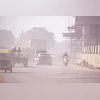
No matter where one lives in India, the air is unhealthy. Climate change and the extreme events it is triggering are only making it worse.
A World Bank report from last year presents an alarming reality: 100 per cent of India’s 1.4 billion population is exposed to PM2.5 levels that exceed the World Health Organization’s (WHO) safe limits. These fine particles — less than 2.5 micrometres in diameter — are the most dangerous form of air pollution, capable of penetrating deep into the lungs and bloodstream.
The WHO recommends an annual average of no more than 5 micrograms per cubic metre (µg/m³) for PM2.5, and a daily average not exceeding 15 µg/m³. India regularly exceeds both thresholds. The sources are varied: Burning of fossil fuels, biomass combustion, vehicular emissions, industrial activities, construction dust, and natural events such as dust storms.
In third week of May, for instance, the Delhi-National Capital Region (NCR) saw a sharp and sudden deterioration in air quality index (AQI), which crossed 250 — categorised as ‘poor’ — as PM2.5 and PM10 levels soared to nearly 20 times the safe limits. The India Meteorological Department (IMD) attributed this spike to strong winds transporting dust from Rajasthan.
For the first time since its inception in 2021, the Commission for Air Quality Management (CAQM) activated Stage 1 of the Graded Response Action Plan (GRAP) in the summer. GRAP-I, which is triggered when AQI reaches 201–300, calls for measures such as dust mitigation, traffic regulation,
and emission control.
According to the IMD, the event occurred due to surface winds blowing dust from western Rajasthan through northern Rajasthan, southern Punjab, and southern Haryana into the capital region.
Delhi often draws the most attention because it is the national capital, but air quality experts point out that several cities in Punjab, Haryana, Uttar Pradesh, and Himachal Pradesh, besides the Union Territory of Chandigarh, face equally severe pollution.
In 2024, India ranked fifth among the world’s most polluted countries, according to IQAir, a Swiss air quality monitoring company. Six of the world’s 10 most polluted cities were in India, with Delhi consistently among the worst.
April this year was Delhi’s most polluted since 2022, with an average AQI of 211. Though conditions improved slightly after May 15 due to favourable meteorological changes, air pollution in India remains a chronic, year-round problem, while worsening in winter.
Ozone spikes in summer
The nature of pollution differs by season. Winter is associated with smog and stubble burning, but summer brings its own hazards, particularly the increase in ozone — a reactive gas not directly emitted but formed when nitrogen oxides and carbon monoxide from combustion sources interact with heat and sunlight.
Ozone is a secondary pollutant formed from other emissions, said Anumita Roychowdhury, executive director of Research and Advocacy at the Centre for Science and Environment (CSE), adding that it is highly reactive and harmful to human health. It’s not as prominent in winter but becomes a major concern in the hotter months, she added.
The underlying causes — vehicular emissions, industrial activity, and construction dust — remain constant throughout the year, but the health impact in summer is exacerbated by ozone formation and increased dust.
Delhi’s geographic disadvantage
While many Indian cities have high AQI levels, Delhi-NCR has a geographic disadvantage, said Chaitanya Kalia, partner and leader at Climate Change and Sustainability Services, EY India.
“Air quality should ideally be around 25 or so, but many Indian cities hover closer to 100 due to construction and transport emissions,” he said, adding that Delhi suffers from the added disadvantage of being landlocked.
Coastal cities such as Mumbai, by contrast, benefit from natural ventilation. Mumbai sees similar sources of pollution, but the sea on both sides allows better wind flow and helps disperse pollutants, Kalia added. Rainfall and high wind speed also help cleanse the air, he said.
Dust may seem benign, but in urban areas, it becomes a toxic mix.
“Emissions from vehicles, industries, and power plants coat the dust with toxins,” said Roychowdhury. “Inhaling it means inhaling these toxins too.” As ozone levels rise, the combination poses even more serious health risks, she cautioned.
North-western India, including Delhi, is annually hit by dust storms during the pre-monsoon period. These storms can carry particulates from as far as Saudi Arabia and even the Sahara, swept in by westerly winds.
According to Sundeep Salvi, director of the Pulmocare Research and Education (PURE) Foundation in Pune, dust’s contribution to total pollution rises significantly in summer — almost doubling compared to its 15 per cent share in winter.
Due to air pollution, diseases like diabetes, strokes, and heart attacks are emerging more frequently, he said.
The University of Chicago’s Air Quality Life Index (AQLI) suggests that residents of Delhi could lose up to 11.9 years of life expectancy because of prolonged PM2.5 exposure.
A 2022 American Heart Association study found that every 10 µg/m³ rise in PM2.5 led to two new diabetes cases, one major cardiovascular event, and two deaths per 1,000 adults. Extrapolated to Delhi, this could mean around 380,000 new diabetes cases, 190,000 cardiovascular events, and 380,000 deaths annually.
A December 2023 study published in The Lancet Planetary Health estimated that air pollution causes an additional 1.5 million deaths in India every year.
“The approach to addressing pollution needs to change; it shouldn’t only be considered a winter issue in certain areas,” said Soumya Swaminathan, former director general, Indian Council of Medical Research (ICMR). The National Clean Air Programme (NCAP) identifies specific cities with poor air quality. “However, pollution levels vary across different regions, and the challenge lies more in implementation rather than lack of knowledge,” she said. Infants, the elderly, pregnant women, and children are particularly vulnerable, she added.
Exposure to high levels of pollution can lead to congenital anomalies, asthma, allergies, and long-term respiratory issues. “Babies with smaller lungs will struggle later. The elderly are at risk of chronic obstructive pulmonary disease, lung cancer, pneumonia, and strokes,” Salvi added.
Economic toll
According to the World Bank, the health burden of air pollution in India amounted to $36.8 billion in 2019, representing 1.36 per cent of the country’s gross domestic product (GDP). This includes $28.8 billion in losses due to premature deaths and another $8 billion related to illness.
Following the 15th Finance Commission’s recommendations, the Indian government allocated $1.65 billion to combat air pollution from the financial year 2021-2026 (FY21 to FY26) across 42 cities with populations over one million. The funding was contingent on these cities reducing pollution levels by 15 per cent annually. By FY23, ₹5,465 crore of the ₹8,357 crore allocated had been utilised.
Delhi has made efforts to combat pollution: Shutting coal-based power plants, removing older vehicles, and adopting cleaner fuels. Yet significant gaps remain.
“The sheer number of vehicles, poor waste management, and unregulated fuels in small industries continue to drive pollution,” said Roychowdhury. “And many low-income households still cannot afford LPG or other clean alternatives.”
She emphasised the need for a regional approach under NCAP, extending beyond Delhi to surrounding states. Pollution doesn’t recognise borders; if NCR cities remain polluted, so will Delhi, she said.
Solutions such as creating dust barriers and conserving the Aravalli forests are key to reducing particulate matter, she added.
While GRAP provides a framework for emergency response, EY’s Kalia stressed the importance of long-term strategies. “Delhi has shifted many commercial vehicles to compressed natural gas (CNG),” he said, adding that the next step was to expand the electric vehicle network. At the same time, many still rely on diesel generator sets due to inconsistent power supply, he said. Mandatory battery backups with inverters, ideally using renewable energy and supported through incentives, would be a better alternative, he said.
Salvi pointed to an overlooked area: Indoor air pollution. People burn mosquito coils and incense sticks inside their homes, he said, adding that one mosquito coil burned for 6–7 hours equals 100 cigarettes, and a single incense stick can be as harmful as 500 cigarettes.
A multipronged approach is the only way forward if India is to breathe better.