Delhi woke up to a thick blanket of smog on Saturday, with the city’s air quality index (AQI) reaching 397 at 8 am, according to the Central Pollution Control Board (CPCB), edging close to the ‘severe’ category. Reduced visibility was reported across the Delhi-NCR region.
Most monitoring stations recorded AQI in the ‘very poor’ category, while some locations exceeded 400. Anand Vihar registered the highest reading at 436, covered in heavy smog. Other areas, including Ashok Vihar (435), ITO (425), DTU (426) and Nehru Nagar (427), also recorded readings in the ‘severe’ category, indicating a sharp decline in air quality.
The poor air quality follows conditions on Friday, when the AQI stood at 349 at 4 pm. Several parts of the national capital remained enveloped in smog, affecting visibility and causing discomfort to residents.
According to AQI categorisation, 0–50 is ‘good’, 51–100 ‘satisfactory’, 101–200 ‘moderate’, 201–300 ‘poor’, 301–400 ‘very poor’ and 401–500 ‘severe’.
Despite the conditions, Delhi Airport reported normal flight operations but warned that low-visibility procedures were in effect. “Passengers are requested to contact their airline for updated flight information,” the advisory stated.
Authorities attributed the poor air quality to low wind speeds, which trap pollutants near the ground, while weak western disturbances are unlikely to provide immediate relief. The city’s Decision Support System identified transport emissions as the largest contributor, followed by industrial activity, with neighbouring districts such as Jhajjar and Sonipat adding to Delhi’s pollution load.
Government response
Delhi Chief Minister Rekha Gupta said on Friday that her administration is working on multiple measures to control pollution effectively and sustainably. She highlighted dust pollution as a key concern and noted that wall-to-wall roads are being constructed across the city at an accelerated pace to mitigate dust emissions.
The Chief Minister’s Office (CMO) said MLAs have been allocated substantial funds for road construction and repairs, with additional resources available if required. Gupta said pollution control requires active public participation. Citizens have been urged to reduce dust and smoke in their surroundings and contribute to cleaner air. She added that flying dust is a major contributor to pollution, and the wall-to-wall road model is a long-term solution for dust control.
Delhi’s weather forecast for today
The India Meteorological Department (IMD) forecast slightly warmer temperatures over the weekend, with minimums around 10 to 12 degrees Celsius and maximums between 23 and 25 degrees Celsius.
Moderate fog is expected to persist, further worsening air quality. Authorities have advised residents to limit outdoor exposure and follow health guidelines as the city faces another challenging winter smog episode.

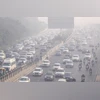 "Delhi covered in dense smog as multiple areas record 'severe' AQI")


