Home / India News / Govt outlines tunnel, elevated road and bypass projects to decongest Delhi
Govt outlines tunnel, elevated road and bypass projects to decongest Delhi
Centre details ₹24,000-crore plan with tunnels, elevated roads and bypasses to ease Delhi traffic and cut travel time across key corridors
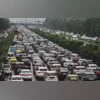
To prevent traffic from entering congested parts of the capital, the minister said a 17 km stretch at Tronica City, which forms part of the Delhi-Dehradun Expressway | (Photo: PTI)
2 min read Last Updated : Feb 06 2026 | 10:26 PM IST
The government has detailed a series of new tunnel, elevated road and bypass projects under its ₹24,000-crore Delhi decongestion plan aimed at easing chronic traffic congestion in the capital.
Several of these projects are either approved or at the detailed project report (DPR) stage, Minister of State for Road Transport and Highways Harsh Malhotra said during a Union Budget briefing on Friday.
Among the key projects is a 5-km tunnel from Shiv Murti in Mahipalpur to Manesar, approved at a cost of ₹3,500 crore, which is expected to cut travel time on the stretch from over an hour to 10-15 minutes, Malhotra said. The tunnel would ease congestion around the airport zone and improve connectivity between Delhi, Gurugram and Manesar.
Malhotra said an elevated road from AIIMS to Mahipalpur, estimated at ₹5,000 crore, has also been approved, with paperwork completed and the project entering initial stages. The elevated corridor will decongest central Delhi while improving traffic flow towards Gurugram.
To prevent traffic from entering congested parts of the capital, the minister said a 17-km stretch at Tronica City, which forms part of the Delhi-Dehradun Expressway, has been approved and is currently at the DPR stage. In addition, a 41-km connectivity from Tronica City to Ghaziabad and Noida has been announced, allowing traffic from Dehradun to reach Noida without passing through Delhi. This road will later be extended to Greater Noida and Faridabad in the second phase.
Malhotra also said several major arterial roads inside Delhi have been brought under the National Highway network to enable signal-free upgrades. The Ashram-Badarpur (Mathura Road) stretch will be redeveloped with underpasses and elevated flyovers, reducing travel time from 45-50 minutes to 10-15 minutes. Similarly, the Punjabi Bagh-Tikri Border road, a 17-km stretch, will be made fully signal-free within 1.5 to 2 years, while similar upgrades are planned for the Mehrauli-Gurgaon road over the same timeframe.
A signal-free circular road at Kalindi Kunj, modelled on existing corridors at AIIMS and Dhaula Kuan, has also been approved at the DPR stage to ease congestion for traffic from Noida, Mayur Vihar and Sarita Vihar. Malhotra linked the decongestion measures to pollution reduction, noting that vehicular emissions account for around 25-26% of Delhi’s pollution, and said smoother traffic flow would directly help lower emission levels.

 "Govt outlines tunnel, elevated road and bypass projects to decongest Delhi")


