How has Isro elevated the Chandrayaan-3 design set to launch in July
The Rs 600 crore projects is the third edition of India's lunar mission following the Chandrayaan-2 crash in 2019
BS Web Team New Delhi The Indian Space Research Organisation (Isro) is gearing up for the launch of Chandrayaan-3 in July. This mission comes after the ‘partial failure’ of Chandrayaan-2, which crash-landed on the Moon's surface in 2019.
What is Chandrayaan-3?
Chandrayaan-3 is the third lunar exploration mission planned by Isro. It will reportedly have a lander and rover, that was similar to its preceding project, Chandrayaan-2. Unlike, Chandrayaan-2, it would not have an orbiter and its propulsion module would be similar to a communications satellite.
Isro had earlier stated that the estimated Rs 600 crore mission aims to demonstrate end-to-end capability of safe landing and roving on the lunar surface.
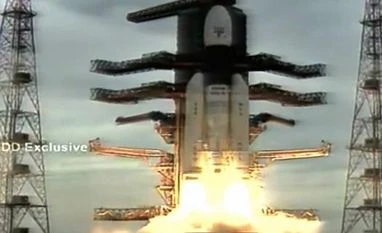
Isro is currently in the process of integrating the Chandrayaan-3 spacecraft with the GSLV-MkIII rocket, which will facilitate its journey to the Moon. Notably, Chandrayaan-3 maintains the same mission architecture as its predecessor while incorporating crucial modifications. In doing so, Chandrayaan-3 will rectify past shortcomings and achieve a successful lunar landing.
The project is set to launch from the Satish Dhawan Space Centre in Sriharikota in the second week of July
What happened with Chandrayaan-2?
Chandrayaan-2 at the time had represented “a significant technological leap compared to previous missions,” as stated by Isro. It comprised an orbiter, lander and rover that would reach, the previously unexplored, south pole of the moon.
According to a written statement to Lok Sabha by Jitendra Singh, the minister of state for the Department of Space on November 26, Chandrayaan-2 had successfully entered the moon’s orbit but deviated from its flight path when it was around 2km above the lunar surface. It made a hard-landing in the second phase of its landing, following a loss of communication to the ground station.
Braking thrusters were cited as the official cause for the crash landing of the Vikram craft.
How has Chandrayaan-3 improved upon Chandrayaan-2?
The chief problem with Chandrayaan-2 was that it failed to soft-land on the moon’s surface and subsequently, lost contact with Isro’s ground station 400 metres before landing. This is how the Chandrayaan-3’s technology is improving the design to ensure a successful soft landing. Some notable changes are:
Simplified payload
Unlike Chandrayaan-2, which comprised the Vikram lander, Pragyan rover, and an orbiter, Chandrayaan-3 will be equipped with a lander and a rover only. The existing orbiter launched with Chandrayaan-2 will be utilised for communication and terrain mapping requirements during the mission.
While Chandrayaan-2's orbiter carried nine in-situ instruments, Chandrayaan-3's propulsion module will house a single instrument called ‘spectro-polarimetry of habitable planet earth’ (SHAPE). SHAPE will analyse Earth's spectrum to generate data on habitable exoplanets, contributing to the study of exoplanetary habitability and the search for potential life beyond our Solar System.
Enhanced lander capabilities Based on the lessons learned from Chandrayaan-2, Chandrayaan-3 incorporates ‘lander hazard detection & avoidance cameras’ to assist in coordination with the orbiter and mission control during the lander's descent to the lunar surface. Chandrayaan-3 will feature two such cameras compared to the single camera on its predecessor.
Additional experiments
Chandrayaan-3 incorporates the laser retroreflector array (LRA), a passive experiment aimed at understanding the dynamics of the Moon system. This addition supplements the three payloads that were also part of the Vikram lander on Chandrayaan-2.
Following the setbacks faced during Chandrayaan-2, Isro's Chandrayaan-3 mission is striving for a successful lunar exploration mission. With optimised payload configurations, improved lander capabilities, and the utilisation of existing resources, the mission is expected to address past challenges and enhance our understanding of the Moon and exoplanetary research.

 "How has Isro elevated the Chandrayaan-3 design set to launch in July")

