The introduction of African cheetahs to India was planned without considering their spatial ecology, according to researchers who warn that the released animals may come into conflict with people in the neighbouring villages.
Spatial ecology addresses the fundamental effects of space on the movement of individual species and on the stability of multispecies communities.
A total of 20 cheetahs from Namibia and South Africa were introduced to Kuno National Park in Madhya Pradesh since last year to establish a free-ranging populationfor the first time since their extinction in India 70 years ago.
Scientists of the Cheetah Research Project of Leibniz-IZW in Namibia argue that in southern Africa, cheetahs live in a stable socio-spatial system with widely spread territories and densities of less than one individual per 100 square kilometres (km).
The plan for cheetahs in Kuno National Park assumes that the high prey density will sustain high cheetah densities, even though there is no evidence for that, they said.
In a letter published in the journal Conservation Science and Practice on Thursday, researchers noted that as Kuno National Park is small, it is likely that the released animals will move far beyond the park's boundaries and cause conflicts with neighbouring villages.
Kuno National Park is an unfenced wilderness area of approximately 17 by 44 kilometers (about 750 km).
Based on a calculation of the local prey density, it was calculated that 21 adult cheetahs could be sustained by the prey base in Kuno National Parkequivalent to a density of about three individuals per 100 km.
Based on their research results from a long-term study of the spatial behaviour of cheetahs in Namibia, as well as comparable work in East Africa, scientists from the Leibniz Institute for Zoo and Leibniz-IZW warn against overestimating the carrying capacity of the area.
The carrying capacity is usually between 0.2 and 1 adult per 100 km for cheetahs under natural conditions. This is true not only for Namibia, but also for the ecologically very different conditions in the Serengeti ecosystem in East Africa which has a much higher density of prey, they said.
The team formulated predictions about the spatial behaviour of cheetahs in their new habitat, identifying controversial issues and hidden core assumptions of the reintroduction plan. These assumptions ignore important aspects of the cheetah socio-spatial system.
The researchers noted that male cheetahs follow two different spatial tactics. Territory holders occupy territories consisting of a collection of important communication hotspots.
Males without territories ("floaters") move and live between existing territories, as do females, with occasional forays into territories to access important information at marking sites, they said.
"The territories do not border each other, their centers are always about 20 to 23 kilometers apart," said Jrg Melzheimer from the Cheetah Research Project.
"The space between the territories is not defended by any male, it is the living and transit space for floaters and females," Melzheimer said in a statement.
This deeply rooted behaviour will also lead to a system in India with territories about 20 to 23 kilometers apart, according to the researchers.
"This distance is independent of the actual size of the territories or the prey base," said Bettina Wachter from the Cheetah Research Project.
"In Namibia, territories are larger and prey density lower, in East Africa territories are smaller and prey density higherbut the distance between territories is a constant and no new territories are established in between. For the reintroduction plan in Kuno National Park, these distances were ignored," Wachter said.
Already with the cheetahs transferred from Namibia in autumn 2022, including three males, the carrying capacity of Kuno National Park has been reached in terms of the cheetahs' territorial system, the researchers said.
"Regardless of the size of their territories established in India, the three Namibian males will have occupied the entire national park, leaving no room for further territories of the additional cheetahs recently transferred from South Africa," they added.
The researchers said there are initial findings that reintroduced cheetahs undertake long forays over an area of several thousand square kilometers in the first few months after translocation.
"We therefore predict that cheetahs will most likely be also found far outside the national park and could come into conflict with farmers in the vicinity of the park," the scientists wrote in their letter.

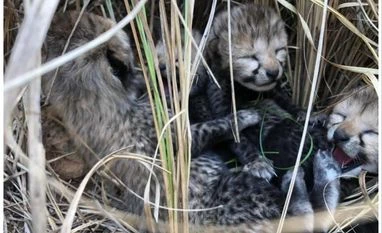 "India's cheetah reintroduction plan ignored spatial ecology: Scientists")


 Connect with us on WhatsApp