Indian Air Force to procure weapons worth Rs 2.5-3 trn in next 7-8 years

Chaudhari said the IAF was constantly monitoring the situation along the Line of Actual Control (LAC), especially in eastern Ladakh
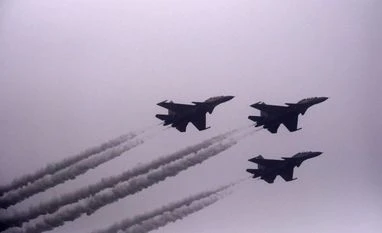
Indian Air Force's Russian-designed Su-30 MKi fighter jets fly over New Delhi
Photo: Bloomberg
Ajai Shukla New Delhi
3 min read Last Updated : Oct 03 2023 | 10:52 PM IST
The Indian Air Force (IAF) is looking at inducting military platforms, equipment, and hardware worth Rs 2.5-3 trillion in the next seven-eight years, Air Chief Marshal V R Chaudhari said on Tuesday.

Addressing a press conference on the eve of the IAF Day, Chaudhari said the IAF was constantly monitoring the situation along the Line of Actual Control (LAC), especially in eastern Ladakh.

“Contracts for LCH (light combat helicopter), LCA (light combat aircraft) Mark1A, HPR (high power radars), and CIWS (close-in weapon systems) are likely to be concluded and the cost is approximately Rs 1.72 trillion.”

“The yearly cash outflow for this year is Rs 41,180 crore. When we talk about contracts signed in this financial year, we are looking at about Rs 16,000 crore for only domestic acquisition schemes,” Chaudhari said.

He said the IAF was pushing ahead with its plan to procure an additional 97 Tejas Mark 1A light combat aircraft, in addition to the 40 Tejas Mark 1 and 83 Tejas Mark IA fighters already contracted with Hindustan Aeronautics Ltd (HAL).

Answering a question, Air Chief Marshal Chaudhari revealed the IAF had taken delivery of three units of S-400 ground-to-air missile systems from Russia and was hoping to receive the remaining two units by next year.

The IAF chief said the uncertain geopolitical situation (in India’s neighbourhood) had reinforced the need for a strong military. He asserted that the IAF would remain a fulcrum to project India's military might in the region.

“Fast-paced development and operationalisation of indigenous aerospace projects, persistent surveillance capability, shortening of sensor to shooter time, long-range precision strikes, and development of multi-domain capability are the main focus areas for the IAF,” the IAF chief said.

He said the induction of the first C-295 medium transport aircraft last month into the IAF’s 11 Squadron was an important milestone in boosting India’s defence industry.

He said the full project, which involved building 16 C-295 aircraft in Spain and 40 aircraft in India, “will contribute immensely by generating 4.25 million man-hours of work involving over 6,000 direct and indirect jobs and skill employment opportunities. Around 125 micro, small, and medium enterprises, spread over seven states, will be involved in the manufacturing of over 13,400 parts, 4,600 sub-assemblies and seven major component assemblies.”

The IAF chief said research and development (R&D) was essential for the armed forces to remain future-ready. The innovations for defence excellence (iDEX) and Make programmes have given impetus to the “Make in India” initiative for defence specific R&D.

Chaudhari said the IAF had taken the lead in indigenisation by signing a contract for counter-UAS (unmanned aerial systems) under the iDEX program. “We are continuing to tread that path and have recently signed the contract for Swarm Unmanned Munition Systems – which was the outcome of an extremely successful Mehar Baba Swarm Drones competition launched by the IAF,” he said.

He was referring to an IAF-organised competition between private defence companies for developing indigenous swarm drones.

“While work is in progress to develop capabilities like manned-unmanned teaming and high altitude pseudo satellites, we are also looking at innovative solutions to resolve day to day functional issues to improve operations, maintenance and administration activities," Chaudhari said.

He also said the IAF had left no stone unturned to ensure successful implementation of the Agnipath scheme for recruiting short-service airmen for the IAF. On the plan for implementing joint theatre commands, he termed it a “work in progress.”

One subscription. Two world-class reads.

Already subscribed? Log in

Subscribe to read the full story →
*Subscribe to Business Standard digital and get complimentary access to The New York Times

Smart Quarterly

₹900

3 Months

₹300/Month

SAVE 25%

Smart Essential

₹2,700

1 Year

₹225/Month

SAVE 46%
*Complimentary New York Times access for the 2nd year will be given after 12 months

Super Saver

₹3,900

2 Years

₹162/Month

Subscribe

Renews automatically, cancel anytime

Here’s what’s included in our digital subscription plans

Exclusive premium stories online

  • Over 30 premium stories daily, handpicked by our editors

Complimentary Access to The New York Times

  • News, Games, Cooking, Audio, Wirecutter & The Athletic

Business Standard Epaper

  • Digital replica of our daily newspaper — with options to read, save, and share

Curated Newsletters

  • Insights on markets, finance, politics, tech, and more delivered to your inbox

Market Analysis & Investment Insights

  • In-depth market analysis & insights with access to The Smart Investor

Archives

  • Repository of articles and publications dating back to 1997

Ad-free Reading

  • Uninterrupted reading experience with no advertisements

Seamless Access Across All Devices

  • Access Business Standard across devices — mobile, tablet, or PC, via web or app

Topics :Indian Air ForceLadakhIndia RussiaChinaIndia China relations

Next Story



