
SC verdict likely on May 1 on divorce without referring to family courts
Article 142 of the Constitution deals with enforcement of decrees and orders of the apex court to do "complete justice" in any matter pending before it
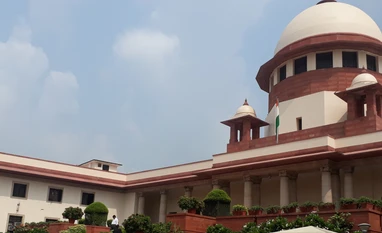 "SC verdict likely on May 1 on divorce without referring to family courts")
Explore Business Standard

Associate Sponsors
Co-sponsor
Article 142 of the Constitution deals with enforcement of decrees and orders of the apex court to do "complete justice" in any matter pending before it
The Supreme Court will likely
pronounce on May 1 its verdict on broad parameters for exercising its vast powers under Article 142 of the Constitution to dissolve marriages between consenting couples without referring them to family courts.
A five-judge constitution bench of Justices SK Kaul, Sanjiv Khanna, A S Oka, Vikram Nath and J K Maheshwari had reserved its judgement on September 29, 2022.
While reserving its order, the court had said social changes take a "little time" and sometimes it is easier to bring a law but difficult to persuade society to change with it.
The apex court had acknowledged the large role a family plays in marriages in India.
Article 142 of the Constitution deals with enforcement of decrees and orders of the apex court to do "complete justice" in any matter pending before it.
The apex court is also considering whether its sweeping powers under Article 142 are inhibited in any manner in a scenario where a marriage has irretrievably broken down in the opinion of the court but one of the parties is resisting divorce.
Two questions, including whether the exercise of such jurisdiction by the SC under Article 142 should not be made at all or whether such exercise should be left to be determined in the facts of every case, were earlier referred to the constitution bench.
One of the questions, which has been referred to it is what could be the broad parameters for the exercise of powers under Article 142 of the Constitution to dissolve a marriage between consenting parties without referring the parties to the family court to wait for the mandatory period prescribed under section 13-B of the Hindu Marriage Act.
On September 20, the apex court had said, "We do believe that another question which would require consideration would be whether the power under Article 142 of the Constitution of India is inhibited in any manner in a scenario where there is an irretrievable breakdown of marriage in the opinion of the court but one of the parties is not consenting to the terms."
Having exercised its sweeping powers under Article 142 for
more than two decades to annul "irretrievably broken marriages", the apex court had in September last year agreed to examine whether it can nullify marriages between estranged couples without both the partners consenting to it.
(Only the headline and picture of this report may have been reworked by the Business Standard staff; the rest of the content is auto-generated from a syndicated feed.)
First Published: Apr 29 2023 | 3:51 PM IST

