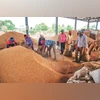
India’s rice production in the 2025 kharif season is estimated to hit a new record of around 124.50 million tonnes (mt), 1.4 per cent more than the same season last year, the first advance estimate of food grains production for the 2025-26 crop season released Wednesday said.
The crop season runs from July to June.
The overall kharif foodgrains production for 2025-26 is estimated to be 173.33 mt, which is around 3.9 mt or 2.3 per cent more than the kharif season of 2024-25.
Sowing for kharif crops starts around June, with the onset of monsoon, and harvesting starts from October onwards.
A good kharif production is expected to further keep inflation under check which has already dropped to multi-year lows.
Also, a bumper rice production could put pressure on the government to step up its official purchases in 2025-26 further
adding on to the bulging state inventories which on November 1 was estimated at 64.31 mt, as against the buffer requirement of 30.77 million tonnes.
Meanwhile, the data showed that production of maize in the kharif season is estimated to be around 28.30 mt which is around 3.5 mt more than the same period last year.
Releasing the first advanced estimate, Union Agriculture Minister Shivraj Singh Chouhan said that though excessive rainfall affected crops in some areas of the country, most parts have benefited significantly from a good monsoon, leading to overall good crop growth.
Meanwhile, total kharif pulses production is projected at 7.41 mt which is slightly lower than the 7.73 mt of last year.
Within this, according to the official data, production of tur (arhar) is estimated at 3.59 mt as against 3.62 mt last season while urad production is estimated at 1.2 mt as against 1.34 mt last year and moong at 1.72 mt against 1.77 mt of last year.
Kharif oilseeds production is estimated at 27.56 mt, according to the first advanced estimate which too is marginally lower than 28.02 million tonnes of last year.
Within oilseeds groundnut production is projected at 11.0 mt, which is around 0.60 mt more than last year, and soybean production estimated at 14.26 mt, down from 15.26 mt of last kharif season.
“These estimates are based on yield trends from previous years, other ground-level inputs and field observations, primarily from the states. These estimates will be revised as actual yield data from crop cutting experiments become available,” an official statement said.
Among other crops, the data showed sugarcane production is estimated at 475.61 mt, an increase of almost 21 mt from last year while cotton production is estimated at 29.21 million bales (one bale weighing 170 kilograms) slightly down from the 29.72 million bales of last year.
ICAR rebuts bias charges in gene-edited rice trials
The Indian Council of Agricultural Research (ICAR) on Wednesday has strongly refuted allegations of bias in the evaluation of two gene-edited rice varieties, asserting that both Pusa DST-1 and DRR Dhan 100 Kamala demonstrated superior performance in their designated growing regions. In a detailed statement, ICAR defended its multi-location trial methodology under the All India Coordinated Research Project on Rice (AICRPR), which has been operational since 1965 and has contributed to the release of over 1,750 rice varieties. The rebuttal comes in response to criticism from The Coalition for a GM-Free India, which had questioned the evaluation process for the two gene-edited lines developed through advanced breeding techniques.
ICAR emphasised that both varieties were specifically evaluated in their target performance environments (TPEs) — the regions where their parent varieties MTU1010 and Samba Mahsuri are already released and cultivated, primarily in southern states under Zone VII. For Pusa DST-1, developed as a salt and alkalinity-tolerant version of MTU1010, ICAR reported significant yield advantages under stress conditions.
Under alkaline conditions in Zone VII, the gene-edited line yielded 3,731 kg per hectare compared to MTU1010’s 3,254 kg per hectare—a 14.66 per cent improvement. Under coastal salinity, it showed 30 per cent yield superiority.

 "India's rice output may hit record high of 124 mt in 2025 kharif season")

