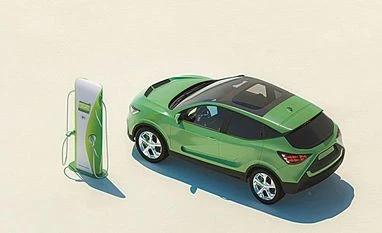
Auto ancillary companies are ramping up investments in research and development (R&D) and manufacturing facilities to cater to the growing electric vehicle (EV) market in India, in response to growing market penetration.
In FY23, e-two-wheeler (E2W) penetration jumped to 4.5 per cent from 1.9 per cent in FY22, data released by the Federation of Automobile Dealers Associations shows. In e-passenger vehicles, sales jumped by 153.47 per cent year-on-year in FY23, and e-three-wheelers saw a 118.25 per cent increase in the same period.
Among the major investors is Gurugram-headquartered Uno Minda, which is building two new plants to develop components for EVs. "The first plant is being set up at Farrukhnagar, Gurugram, with a capital outlay of Rs. 390 crore over six years. The outlay in the initial two years would be around Rs. 160 crore," a spokesperson said.
The Farrukhnagar plant will manufacture EV-specific products, such as battery management systems (BMSs), chargers (on board and off board), body control modules, AC-DC converter and it is expected to be commissioned in the second half of FY24.
Another plant is being set up at Bawal, Haryana, at a cost of about Rs. 110 crore over the next six years. The Bawal plant, which will manufacture traction motors for EVs, is expected to be commissioned by the end of FY24.
The company spends roughly 3 per cent of its revenues on R&D spread out through 30 centres in India, Germany and Spain. Over the past few years, most of these investments were deployed on developing EV-specific products, the spokesperson said. The company has already secured Rs. 1,900 crore worth of orders from EV companies and the latter’s share in the total order book is growing.
Delhi-based Flash Electronics is looking at deriving a bigger share of revenues from EV components such as electrical drivetrains, motors and controllers. Sanjeev Vasdev, managing director, said the target was to raise it from the current 5 per cent of turnover over the next three years to 30 per cent, during which time it expects total turnover to double
On July 15, Flash Electronics will inaugurate its new R&D centre in Pune, which will have 150 engineers, to focus on innovations in EV-related products, Vasdev added. The company is also building a Rs. 200 crore factory to produce one million drivetrains and BMSs annually.
Last month, Japanese company Musashi Auto, which makes transmission components, announced that it will invest Rs. 70 crore on an assembly line at its Bengaluru facility to make parts for EVs.
In May, Samvardhana Motherson International (SAMIL), one of India's largest auto component makers, said 20 per cent of its total order book of about $70 billion is geared towards pure EVs.
In February, SAMIL had announced it is buying SAS Autosystemtechnik, which manufactures automobile cockpit modules, from French company Faurecia for Rs. 4,790 crore. "This acquisition will transform Motherson Group to be a leading assembler of cockpits modules globally, with special focus on EV models," said Vivek Chaand Sehgal, chairman, SAMIL.
Tyre makers are also getting into the EV act. EV-specific tyres are created precisely to fit the needs of EVs such as higher torque, low noise, heavier weight on tyres due to battery weight, and optimum rolling resistance for longer range.
JK Tyre & Industries has made significant inroads into the EV buses and two-wheeler markets. Managing Director Anshuman Singhania said there is a "huge potential for EV tyres as India is likely to see a spike in EV demand and by 2030 we plan to see a market share of more than 25 per cent".
The development of EV-oriented technology is the company's key focus currently, he said. "We have already invested more than Rs. 300 crore in our Global Tech Centre in Mysuru – Raghupati Singhania Centre of Excellence," he noted, adding that about Rs. 50 crore have been pushed in for development, testing, tooling and so on for EV-specific tyres.
Apollo Tyres is currently supplying its EV-specific tyres to the majority of EV makers in India. The R&D expenditure of the company was the highest amongst its domestic peers, Satish Sharma, president (Asia Pacific Middle East and Africa), Apollo Tyres, told the newspaper.
"Considering the growing importance of EVs, a significant amount of our R&D spend is going towards development of tyres for different segments of EVs," he added, but declined to offer more details.
In the past year, Apollo has introduced EV-specific tyres for passenger vehicle, two-wheeler and commercial vehicle segments. "In addition, the R&D team is closely interacting with the OEMs," Sharma said.
Lubricants is another area of specialisation. In 2022, Castrol globally launched ON, a range of EV transmission fluids, coolants, and greases. Two out of every three major car manufacturers worldwide currently use ON fluids as a part of their EV factory fill.
Sandeep Sangwan, managing director, Castrol India, said the company may explore manufacturing fluids dedicated to EVs in India as demand picks up. "By establishing a production line or facility specifically for EV products in India, we aim to cater to the domestic market's needs," Sangwan added.
The current contribution of EV fluid sales to Castrol India's total sales (Rs. 4,774 crore in 2022) is very low as the EV penetration in India is currently very low, he explained. "In the next two to five years, we expect a slightly higher proportion of our sales from the sale of EV-specific products," he added.
Gulf Oil Lubricants India sells EV lubricants for two-wheelers, three-wheelers, PVs as well as commercial vehicles. Its Managing Director & Chief Executive Officer, Ravi Chawla, said its global R&D centre in Chennai is working closely with Indian automakers to develop EV-specific lubricants.
"We already supply EV fluids to companies like Switch, Piaggio, and Altigreen. Additionally, we have entered into an exclusive partnership with Altigreen for the supply of EV fluids such as brake and gear oils. This partnership allows us to manufacture customised EV fluids for commercial electric vehicles," Chawla pointed out.
Gulf Oil is also focusing on increasing its footprint in the area of EV charging solutions. Last year, it had acquired a 26 per cent stake in TechPerspect Software, which specialises in software solutions for EV charging, BMS, EV fleet management, grid load management, etc. Gulf Oil is also the biggest investor in Indra Charging Solutions, which manufactures multiple types of EV chargers.
"We believe that these investments (TechPerspect and Indra) will help us become a leading provider of EV lubricants and charging solutions in India," Chawla mentioned.
With EV sales slowing in the first few months of FY24 with the government cutting back on its subsidy schemes, it is unclear yet whether ancillary industries will decelerate their drive towards EVs.
Log book
Uno Minda is establishing two plants to produce EV-specific products
Most of Uno Minda’s R&D budget has gone to develop EV-specific products
Flash Electronics expects EV-related products to account for 30 per cent of turnover in three years
Musashi Auto is setting up an assembly line at its Benglauru facility to make EV parts
Development of EV-oriented technology is the JK Tyres’ “key focus”currently
A “significant amount” of Apollo Tyres’ R&D spend is going towards development of EV-specific tyres