Auto production in 'precarious' phase as suppliers feel 'stressed': Siam

As the inflation rate continues to rise, workers, including those at automobile and auto component makers, in Noida and Gurugram have protested low wages over the past few days

Automakers, car makers, cars, automobile manufacturers, auto industry
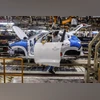
India’s auto sector faces LPG-linked supply stress despite strong sales, with rising costs and fuel uncertainty shaping production risks and boosting EV interest | Image: Bloomberg
Deepak Patel New Delhi
4 min read Last Updated : Apr 14 2026 | 11:33 PM IST
Automobile production in India is in a “precarious” phase because a  reduced supply of liquefied petroleum gas (LPG) owing to the conflict in West Asia is affecting the manufacture of components, said Shailesh Chandra, president of the Society of Indian Automobile Manufacturers (Siam), on Tuesday.
 
Chandra said that while headline sales and production numbers had remained strong till now, underlying supply chains, particularly among vendors dependent on LPG, were facing the strain and were “stressed”.
 
“Production-wise I have not seen much impact ... but ‘precarious’ is the word I would use,” he said, adding that suppliers were often providing visibility for just a few days at a time. 
 
“Clarity from suppliers, especially where there was dependence on LPG, in March came every third day about supplies for the next three days. So it has been a bit stressed,” he added.
 
He noted some companies had managed disruption by resorting to costlier logistics such as air freight, even as input costs were rising. At present, there is limited visibility beyond a week.
 
“I can say one week ... we should not be disrupted to that extent,” he said.
 
As the inflation rate continues to rise, workers, including those at automobile and auto component makers, in Noida and Gurugram have protested low wages over the past few days. 
 
In response, the Uttar Pradesh and Haryana governments have increased minimum wages.
 
When asked if the protests had impacted production, Chandra replied: “Not in a big way... but definitely in some pockets.”
 
On the impact of minimum wage increases in Haryana and Uttar Pradesh, he said this could increase costs for an automaker, though it might remain a smaller factor compared to rising commodity (raw material) prices.
 
Despite these near-term concerns, the industry closed FY26 on a strong note, with all segments recording their highest ever annual sales in seven years.
 
According to the Siam data released on Tuesday, sales of passenger vehicles stood at 4.643 million units in FY26, up 7.9 per cent year-on-year (Y-o-Y).
 
Sales of commercial vehicles were 1.08 million units, growing 12.6 per cent, while three-wheelers saw sales of 836,000 units, up 12.8 per cent.
 
Two-wheeler sales reached 21.7 million units, marking a 10.7 per cent increase.
 
March also saw robust momentum, with sales of passenger vehicles at 442,460 units, up 16 per cent Y-o-Y, and two-wheeler sales at 1.976 million units, up 19.3 per cent. He attributed the growth to positive sentiment from reforms in goods and services tax and multiple repo rate cuts.
 
Chandra also flagged early signs of changing consumer behaviour amid uncertainty around fuel prices.
 
“While inquiries for cars are strong, conversion is delayed ... especially at the entry (entry-level cars) side,” he said, adding that this trend had not yet translated into a year-on-year decline in growth.
 
The conflict is also influencing demand patterns, particularly for electric vehicles (EVs). EV sales saw a big spike in March, he said, and a portion of this jump could be attributed to concerns around fuel availability. 
 
“We saw 20 to 30 per cent (of the demand) coming because of the West Asia crisis, at least in our case,” he said, referring to the data from Tata Motors’ passenger vehicle business, where he serves as managing director and chief executive officer.
 
He added that apprehensions around fuel supply were more intense in March, even though retail fuel prices in India had not yet seen a commensurate increase despite a surge in prices of global crude oil in the past one month.
 
“If the retail fuel prices in India also increase, I think there will be uptick in EV demand,” he said.
 
On the outlook, Chandra said growth in the first half of FY27 was expected to remain strong if the conflict did not prolong significantly or lead to sharp increases in fuel and commodity prices. 
 

One subscription. Two world-class reads.

Already subscribed? Log in

Subscribe to read the full story →
*Subscribe to Business Standard digital and get complimentary access to The New York Times

Smart Quarterly

₹900

3 Months

₹300/Month

SAVE 25%

Smart Essential

₹2,700

1 Year

₹225/Month

SAVE 46%
*Complimentary New York Times access for the 2nd year will be given after 12 months

Super Saver

₹3,900

2 Years

₹162/Month

Subscribe

Renews automatically, cancel anytime

Here’s what’s included in our digital subscription plans

Exclusive premium stories online

  • Over 30 premium stories daily, handpicked by our editors

Complimentary Access to The New York Times

  • News, Games, Cooking, Audio, Wirecutter & The Athletic

Business Standard Epaper

  • Digital replica of our daily newspaper — with options to read, save, and share

Curated Newsletters

  • Insights on markets, finance, politics, tech, and more delivered to your inbox

Market Analysis & Investment Insights

  • In-depth market analysis & insights with access to The Smart Investor

Archives

  • Repository of articles and publications dating back to 1997

Ad-free Reading

  • Uninterrupted reading experience with no advertisements

Seamless Access Across All Devices

  • Access Business Standard across devices — mobile, tablet, or PC, via web or app

Topics :SiamAuto industryWest Asia

Next Story