Home / Industry / News / Not enough demand for satellite launch market in India yet: Isro chairman
Not enough demand for satellite launch market in India yet: Isro chairman
Addressing the India Space Congress 2024, he said big companies are willing to enter the space sector but they are concerned about the timeline for breaking even and securing orders
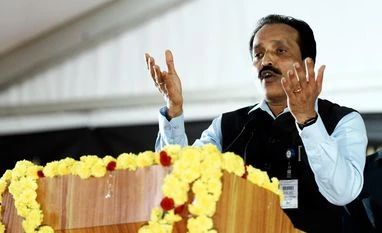
"It is the bigger challenge of convincing investors to come in a big way in big state projects," the leading space scientist said. (Photo: PTI)
3 min read Last Updated : Jun 26 2024 | 6:01 PM IST
ISRO Chairman S Somanath on Wednesday said there is not enough internal demand for the satellite launch market in India but it can be created through more work on the application of satellite technology.
Addressing the India Space Congress 2024, he said big companies are willing to enter the space sector but they are concerned about the timeline for breaking even and securing orders.
"When I talk to many of those industries who are willing to come and set up facilities, they are all very ready to do it. But they are asking when they are going to break even and where the orders are so that they can safely invest in this. I think this is a big question.
"It is the bigger challenge of convincing investors to come in a big way in big state projects," the leading space scientist said.
At a press conference on the sidelines of the Space Congress, he said, "We need to create more internal demand. That implies internal demand is not enough. All of us are working towards that. The demand will come from the user side, from the communication segment, which, of course, includes big satellite builders."
"We would like to find orbital slots and frequencies which can be given to industry to build satellites and launchers. This is the first step towards creating internal demand. InSpace has already announced a funding plan to create a new earth observation constellation. That's again another step towards creating internal demand."
Somanath also said although the cost of accessing space has decreased significantly globally, largely due to SpaceX, India's rocket costs have not seen similar reductions.
Reducing costs could boost small satellite launches and attract new participants in the space sector, he said.
Somanath mentioned that Prime Minister Narendra Modi's vision for Amrit Kaal includes extending human space activity beyond the Gaganyaan mission, with the goal of landing on the moon by 2040.
However, he said India's current rockets are not sufficient for round trips to the moon. Developing rockets with higher payload capacity is essential for both bringing back samples and future human missions, the ISRO chairman said.
"Though GSLV MKIII (LVM3) is the biggest rocket that we have, it is not big enough. It has just enough capability to go up to the moon, but it cannot even come back. We need to develop the capability to bring samples back and then send humans to the moon and bring them back," he said.
Somanath said the development of such capabilities must also consider commercial sustainability. Space activities should support a broader ecosystem and not just focus on lunar missions, he said.
The scientist said India's industrial capacity to produce launchers needs significant enhancement and more companies must enter this field to increase production capabilities.
Somanath told reporters that GSAT-20 is set to launch in mid-August onboard Falcon 9 and it has received clearance to be moved to the United States for launch.
(Only the headline and picture of this report may have been reworked by the Business Standard staff; the rest of the content is auto-generated from a syndicated feed.)


 "Not enough demand for satellite launch market in India yet: Isro chairman")

