Religious tourism turns key revenue stream for travel, hospitality firms

Religious and spiritual tourism has been the fastest growing segment for us across the portfolio, says Jatin Khanna
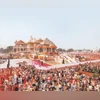
Ram mandir, Ayodhya
For travel major MakeMyTrip, spiritual tourism is emerging as a significant growth driver within India's domestic travel landscape.
Gulveen Aulakh New Delhi
4 min read Last Updated : Jun 10 2025 | 12:05 AM IST
India’s religious and spiritual tourism is not just about people but is also raking in the moolah. The myriad temples, religious sites and spiritual locations — which have long provided salvation to people — are also turning out to be key revenue-generating streams for these firms.
 
“Religious and spiritual tourism has been the fastest-growing segment for us across the portfolio, with its share at 20 per cent in terms of revenue. The potential for growth is very high. We’ve just signed a 129-key Sarovar Premiere in Ayodhya, and are coming up with a 70-key Sarovar Portico in Mathura,” Jatin Khanna, chief executive officer (CEO) at Sarovar Hotels, told Business Standard.
 
“We are constantly evaluating new locations as more destinations keep emerging,” he said, noting that locations of Ujjain, Dwarkadish (Gujarat) and Puri (Odisha) will add to the existing circuits of Bodh Gaya, Mathura-Vrindavan and Haridwar.
 
Radisson Hotel Group, which opened the first hotel in Ayodhya, has signed another hotel in the vicinity.
 
“Occupancy levels are good. You’ll see after five years, there will be 10 times the number of keys, but still there will be a dearth of rooms,” said KB Kachru, chairman, South Asia, Radisson Hotel Group.
 
He noted that besides Radisson, a number of hotels, including Indian Hotels Company Ltd (Taj), ITC Hotels, Park Hotels and Lemon Tree Hotels have signed up locations at Ayodhya.
 
Taj, for instance, has three existing signings and a fourth one coming up called Taj Ayodhya, a 7.2 acre, 300-rooms luxury resort. It includes 29 luxury villas, to be designed by Indian fashion designer Tarun Tahiliani.
 
Going beyond the allure of the Ram Temple, Radisson signed Radisson Blu Hotel Deoghar in Jharkhand, and Radisson RED Puri in Odisha. With this, it is targeting high-potential markets within the religious and spiritual segments, including the annual Ratha Yatra at the Shree Jagannath Temple. 
 
Lalit Hotels’s chairperson and managing director Jyotsna Suri told Business Standard last week that the company was looking at religious and spiritual circuits like Chitrakoot, Ayodhya, Bodh Gaya, for expanding its mid-scale brand the Lalit Traveller.
 
“Religious and spiritual tourism is coming up in a big way and we want to tap into it,” she said.
 
For travel major MakeMyTrip, spiritual tourism is emerging as a significant growth driver within India's domestic travel landscape.
 
It saw volume growth from ‘pilgrimage cities’, including Mahakumbh in FY24 rise by 95 per cent over the previous year, and 147 per cent in the March quarter alone. The travel giant wants to tap this segment in a big way.
 
“We saw strong demand from both first-time and repeat travellers seeking culturally-rich and spiritually meaningful experiences. We intend to continue building on this trend by expanding our offerings in key pilgrimage circuits, enhancing accessibility and creating curated travel experiences that cater to this fast-growing segment,” said co-founder and Group CEO Rajesh Magow.
 
HVS Anarock data showed the scale of India’s religious tourism segment. Varanasi welcomed 62 million domestic and 184,000 international visitors, Mathura hosted 68 million tourists and Tirupati attracted over 25 million devotees during the year.
 
The Maha Kumbh Mela in Prayagraj, which saw 660 million visitors over just 45 days in January-February this year, generated Rs 3 trillion in economic activity, with 7–8 per cent spent on hotels and lodging.
 
Prayagraj Airport also witnessed a surge in traffic, handling over 560,000 passengers and 5,225 flights. This includes 1,775 charters during the 45-day period, showcasing the country’s pilgrimage power.
 
“Faith-based tourism, which accounts for over 60 per cent of domestic travel in the country, has seen a remarkable surge, led by the grand inauguration of the Ram Mandir in Ayodhya, which drew 135.5 million domestic visitors — surpassing the Taj Mahal as Uttar Pradesh’s most visited site. This momentum is expected to sustain driven by continued influx of travellers to spiritual destinations such as Ayodhya, Kedarnath, and Varanasi, and the growing appeal of wellness and medical tourism,” said analysts in the India Hospitality Industry Overview 2024.
 
(With inputs from Akshara Srivastava)
 

One subscription. Two world-class reads.

Already subscribed? Log in

Subscribe to read the full story →
*Subscribe to Business Standard digital and get complimentary access to The New York Times

Smart Quarterly

₹900

3 Months

₹300/Month

SAVE 25%

Smart Essential

₹2,700

1 Year

₹225/Month

SAVE 46%
*Complimentary New York Times access for the 2nd year will be given after 12 months

Super Saver

₹3,900

2 Years

₹162/Month

Subscribe

Renews automatically, cancel anytime

Here’s what’s included in our digital subscription plans

Exclusive premium stories online

  • Over 30 premium stories daily, handpicked by our editors

Complimentary Access to The New York Times

  • News, Games, Cooking, Audio, Wirecutter & The Athletic

Business Standard Epaper

  • Digital replica of our daily newspaper — with options to read, save, and share

Curated Newsletters

  • Insights on markets, finance, politics, tech, and more delivered to your inbox

Market Analysis & Investment Insights

  • In-depth market analysis & insights with access to The Smart Investor

Archives

  • Repository of articles and publications dating back to 1997

Ad-free Reading

  • Uninterrupted reading experience with no advertisements

Seamless Access Across All Devices

  • Access Business Standard across devices — mobile, tablet, or PC, via web or app

Topics :Religious tourismHospitality industryTravel firmsMaha Kumbh MelaTourists

Next Story


