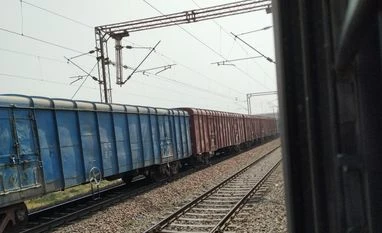
The parliamentary standing committee on railways has asked the national transporter to diversify beyond staple bulk commodities like coal, iron ore, and cement to better its freight performance, and recommended a service model similar to the passenger system.
While the standing committee’s report is not available yet, a statement by the committee on Monday said that freight remains the backbone of Indian Railways, contributing nearly 65 per cent of its revenue and coal, iron ore and cement constitute more than 60 per cent of freight loading and revenue generation through freight operation.
“The committee felt the urgent need to improve the average speed of freight trains which has been 25 km/h during 2023-24. Additionally, the committee stressed the need for prioritising Dedicated Freight Corridors (DFCs) development and usage to ease congestion on high-density routes and improve freight efficiency. The committee recommended a commercially viable, market-driven approach, with a focus on diversification beyond bulk commodities and to introduce a freight service model, similar to the passenger segment, offering varied options based on cost, speed and service levels,” the panel, chaired by Baratiya Janata Party MP from Andhra Pradesh CM Ramesh, said.
Moreover, the committee also asked the Indian Railways to explore alternative avenues to boost passenger revenues by including service-based revenue generation, improved onboard amenities, thereby increasing passenger base by allowing transition of travelers from road and air transport to more sustainable railway alternatives.
The committee observed that 1,337 stations have been identified for development under Amrit Bharat Station Scheme and out of these, tenders for development works have been awarded and works are in progress at 1,202 stations.
However, only one station has been upgraded in the financial 2024-25 (FY25) against a target of over 450. In a previous report, this paper had highlighted that as of December, the national transporter had spent only 58 per cent of its allocated capital expenditure for the financial year on customer amenities.
“To address delays, the committee desired the ministry to establish a dedicated task force for better project oversight and coordination among stakeholders and emphasised early engagement with local representatives and state governments to reduce bureaucratic delays. The committee further recommended that the redevelopment of stations under the scheme should focus on improving crowd management to prevent any untoward incidents. The committee also urged the ministry to evaluate the PPP model’s success, particularly at Rani Kamalapati Railway Station, to identify best practices and potential scalability of the same to other stations while attracting private investment and expertise,” the panel said.
The committee also noted that around Rs 71,000 crore of the sanctioned Rs 1.08 trillion has been spent on the flagship Mumbai-Ahmedabad bullet train project, with physical progress at 48 per cent. It also advocated indeginisation of the technology going forward.
“To support the long-term sustainability of high-speed rail operations, the committee desired that indigenous manufacturing of Shinkansen technology components under the Make-in-India initiative be expanded and the ministry should prioritise the development of a skilled workforce by scaling up training programmes at HSRTI Vadodara and leveraging international expertise,” it said.
For upcoming HSR projects, the committee has recommended that feasibility studies be conducted, innovative financing models may be explored, and funding may be secured before sanctioning new corridors.
A Call for Change
> Freight trains’ average speed (25 km/h) must improve; prioritisation of Dedicated Freight Corridors (DFCs) recommended
> New freight service model proposed, similar to passenger trains, offering varied pricing and speed options
> Passenger revenue boost suggested through improved services and shifting travelers from road and air to trains
> Station redevelopment under Amrit Bharat Scheme lagging, with only 1 of 450 targeted stations upgraded in FY25
> Committee recommends a task force for better project oversight and exploring private-public partnerships for station modernisation

 "Improve freight services, diversify beyond coal, cement: Rlys parl panel")


 Connect with us on WhatsApp