Hammers fall silent: Why Odisha's bell metal craft is melting away

Though the craft is ingrained in Odisha's traditions, the artisans struggle with low wages, lack of policy support, and the vice-like grip of middlemen
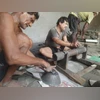
Antaryami Mahana making a brass bowl
Krishnanshu Panda New Delhi
5 min read Last Updated : Jun 27 2025 | 6:02 PM IST
Once alive with the hammering and polishing of kansa (bell metal, an alloy of copper and tin) and brass products, the streets of Rampela, Odisha, have fallen silent over the past decade. 
 
A visit to one of the clusters, Rampela in western Odisha, reflects the sharp decline in the Kansari (bell metal and brass artisan) community. The number of artisans has shrunk from 200 to a mere 20 in a decade. Today, only a few pockets remain where the shala, or workshop, still ignites its furnace at 3 am.
 
The story is the same for every cluster across the state. 
 
The PM Vishwakarma Scheme, launched in 2023, could have helped script a revival. However, at a time when the central government is trying to support handicrafts, the Kansari artisans find no representation in this scheme.
 
Despite bell metal’s deep importance in Odisha’s traditions — from a newborn’s first meal in a kansa bowl to rituals in marriage ceremonies — the craft was not among the 18 trades eligible for support under the scheme.
 
“The work has reduced. Earlier, there were more than 25 shalas here. Now, only two remain operational, run by my brother and me,” said Antaryami Mahana (78), a sixth-generation Kansari who still practices the craft. The decline of the community has been observed across Odisha, according to Odisha Craft Odyssey (OCO), a curatorial residency programme that documents artisans statewide. 
Mahana Brothers in front of their shala
 
A fragile system
 
Making a kansa or brass item is a painstaking process, requiring melting raw metal at extreme temperatures and simultaneous hammering by at least four artisans. Yet this hard work earns them an average of Rs 300 per kg as making charges, which is then divided among all the workers in the workshop. 
 
Aaditya Mahana, who quit the craft in 1989 to become an intercity cab driver, cited low income as his main reason. “I earn the same amount in one trip that I used to earn in a month of making kansa bowls,” he said. Mahana added that the younger generation does not want to pursue the laborious profession because it pays so little.
 
While brass and bell metal products now sell at higher prices, the artisans’ making charges remain unchanged. 
 
Sandeep Hota, an advisory board member at OCO, said middlemen control these rates because artisans depend on them. “There is a mahajan’s (middleman’s) arbitrage, where buyers realise that in an economy with dwindling demand for your craft, and where they’re your only link to buyers, they can keep the making charges low because craftsmen have no alternatives,” he explained.
 
The community’s problems don’t end there. Consumers increasingly prefer steel and aluminium products due to lower prices and easier maintenance. Meanwhile, there’s a growing shortage of raw materials in the shalas. 
 
Antaryami Mahana said he could keep his workshop running year-round if middlemen continued supplying raw materials. “Sahukaars (middlemen) are not giving us raw material now, maybe because it’s not selling. So the artisans are taking other work to feed their families,” he said.
 
In some clusters, artisans and shop owners resort to barter, exchanging finished products for an equivalent amount of raw material. 
 
Kirti Kumari, an archivist fellow at OCO, noted that many Kansari are forced to melt old kansa to make new products due to the shortage.
 
She added: “We’ve also come across cases where Kansari artisans died while working because of the extreme heat in the shala. For a craft that demands so much labour, there are no insurance or safety facilities.” 
A brass bowl being polished in Rampela cluster
 
Search for sustained support
 
With the shalas closing, local shops in the Rampela cluster have begun importing brass items from factories in Uttar Pradesh and Maharashtra, according to one shop owner. 
 
The Odisha government launched the Mukhyamantri Baristha Bunakar and Karigara Sahayata Yojana (MBBKSY) in 2024 to provide financial assistance and welfare benefits to senior weavers and handicraft artisans, including the Kansari.
 
The state government also applied for a geographical indication (GI) tag in 2022 for bell metal and brass products. The current status of the GI application and the implementation of the MBBKSY scheme are not publicly available. The Odisha Handicraft Department did not respond to queries from Business Standard on the matter by the time of going to press.
 
There is also a lack of documentation about the number of handicraft artisans in the state. 
 
The last available data on the Kansari community dates back to 1987. “There is very little craft documentation. That’s the sad reality of Odisha’s craft sector. Any attempt by OCO is aimed at bridging that gap,” said Hota. 
 
OCO is set to launch a book in July that documents the craft and community of the Kansari. An excerpt from the publication reads: “…this layered bilingual publication opens up possibilities for viewing the craft of Bell Metal through various unseen perspectives.”

One subscription. Two world-class reads.

Already subscribed? Log in

Subscribe to read the full story →
*Subscribe to Business Standard digital and get complimentary access to The New York Times

Smart Quarterly

₹900

3 Months

₹300/Month

SAVE 25%

Smart Essential

₹2,700

1 Year

₹225/Month

SAVE 46%
*Complimentary New York Times access for the 2nd year will be given after 12 months

Super Saver

₹3,900

2 Years

₹162/Month

Subscribe

Renews automatically, cancel anytime

Here’s what’s included in our digital subscription plans

Exclusive premium stories online

  • Over 30 premium stories daily, handpicked by our editors

Complimentary Access to The New York Times

  • News, Games, Cooking, Audio, Wirecutter & The Athletic

Business Standard Epaper

  • Digital replica of our daily newspaper — with options to read, save, and share

Curated Newsletters

  • Insights on markets, finance, politics, tech, and more delivered to your inbox

Market Analysis & Investment Insights

  • In-depth market analysis & insights with access to The Smart Investor

Archives

  • Repository of articles and publications dating back to 1997

Ad-free Reading

  • Uninterrupted reading experience with no advertisements

Seamless Access Across All Devices

  • Access Business Standard across devices — mobile, tablet, or PC, via web or app

Topics :local artisansOdisha Ringing Bellsskills gaps

Next Story



