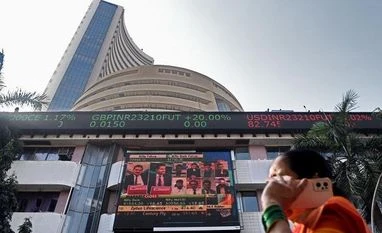
India's m-cap falls below $3 trn-mark; analysts see bumpy road ahead
So far in 2023, benchmark indices the S&P BSE Sensex and Nifty50 have tumbled up to 6.4 per cent, eroding India's m-cap by nearly $300 billion
Lovisha Darad New Delhi The chaos in the last two weeks in the global banking and financial sectors triggered fears of an imminent recession, driving India's market capitalisation (m-cap) below $3 trillion - a level last seen on June 23, 2022.
Meanwhile ,the US continues to hold the top spot with $41.8-trillion m-cap, followed by China ($10.6 trillion), Japan ($5.59 trillion), Hong Kong ($5.35 trillion), and France ($3.06 trillion), data shows.
So far in 2023, benchmark indices the S&P BSE Sensex and Nifty50 have tumbled up to 6.4 per cent, eroding India's m-cap by nearly $300 billion. The underperformance was visible across the broader markets as well, as Nifty MidCap 100 and Nifty Smallcap 100 indices have declined up to 8.3 per cent, during the same period.
The sell-off comes amid a rout in banking stocks, which first witnessed panic selling due to the Adani-Hidenburg crisis, and later due to fears of global contagion from failures in the US banking system, which included Silicon Valley Bank, Signature Bank, and Silvergate Bank. This crisis in confidence in the global banking sector, therefore, had a rub-off effect on Indian banks. The Nifty Bank index, for instance, has dropped over 8.3 per cent year-to-date.
That apart, last week, the US Fed delivered interest rate hike on expected lines - up 25 basis points to bring fed funds target within 4.75-5 per cent. However, analysts sense that there is more room for additional rate increase as the US Fed continued focus on bringing down inflation levels to its 2 per cent target remains undiminished.
Therefore, going ahead, analysts believe that higher interest rates, and tougher monetary policy will continue to weigh on investors' sentiment in the near-term.
"The equity markets remained under stress as the transmission of the news of bank failures adversely affected the sentiment. The hike in the base rate by the US Federal Reserve (US Fed), Bank of England, and the persistence of inflation has been viewed as negative for the markets in the immediate term," said Joseph Thomas, Head of Research, Emkay Wealth Management.
Historically, there has been strong co-movement between US and EM equities. Looking at historical monthly returns for US and EM equities since 2001, they have moved in the same direction ~76 per cent of the time, said analysts at Emkay Wealth in a recent note.
"Overall, when both US and EM equities had positive months, EM equities returned 5.1 per cent on average vs 3.5 per cent for the US, while in the opposite scenario (US and EM both –ve), EM equities delivered -6 per cent returns vs -4.6 per cent for the US," they added.
Meanwhile, the persistent sell-off by foreign portfolio investors, too, dented overall markets. So far this month, FPIs have sold Rs 246 crore worth of equities, with only five days of buying periods.
Dr V K Vijayakumar, Chief Investment Strategist at Geojit Financial Services believes that FPIs have been sellers in most emerging markets except China which continues to witness inflows due to the opening-up trade.
"FPIs are likely to be cautious in the near-term since there is a risk-off in equity markets globally due to the stress in the US banking system and crash in banking stocks. In India, inflows will be mainly targeted at domestic economy-facing sectors like banking, capital goods and autos. A contrarian trend in favour of IT and pharmaceuticals is likely in the near-term since the valuations of these segments have turned attractive after the recent corrections," he added.

 "India's m-cap falls below $3 trn-mark; analysts see bumpy road ahead")


 Connect with us on WhatsApp