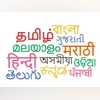
Languages die not with a bang but a whimper: Word by word, speaker by speaker, until there’s no one left to pass them on. “Languages have no existence without people,” wrote British linguist David Crystal in Language Death, capturing how spoken tongues fade.
In India, over 250 languages have vanished in five decades, and nearly 400 more are facing extinction, according to the People’s Linguistic Survey of India (PLSI). Unesco lists 197 Indian languages as endangered.
This is cultural deletion. Most language loss happens not by force but by choice. It begins when a parent drops Kurukh in favour of Hindi, believing it will help their child succeed. It continues when schools ignore Irula, Bhojpuri, or Kui — and punish students for using their native tongue. Today, children are more likely to recite “Twinkle Twinkle” than “Machli Jal Ki Rani Hai”, let alone a rhyme in Bhili or Dogri.
Language slips when bureaucracy prizes Sanskritised Hindi or English, and scoffs at Bagheli or Awadhi. The message is unmistakable: Your language lacks worth. And eventually, people internalise that belief.
The market doesn’t reward poetry in Kokborok. It rewards the language of commerce and governance — English, Hindi, or whichever language the power speaks. Then there’s the digital gap: Over 90 per cent of web content exists in just 10 languages, mainly English. Indian languages barely feature.
Saimar, once spoken in Tripura, now has fewer than 10 speakers, not due to disaster but because it was never taught in schools, printed in books, or supported by tech. Kui, in Odisha, can’t be typed on WhatsApp; it lacks Unicode support. You’ll find more Khasi etched on gravestones than on YouTube.Languages vanish fast. Much of this decay feels inevitable — but much of it is by design. Take Hindi, not the informal Hindi of Delhi’s streets, but the standardised, textbook version made the Union’s official language in 1947. This Hindi, based on Khari Boli (a dialect once thought unrefined), was elevated by colonial officials and nationalists. Urdu, its sibling shaped by Persian influences, was labelled “foreign”. In 1881, Hindi in Devanagari became Bihar’s official language, replacing Urdu. That set a pattern: Alternative scripts were abandoned, “dialects” downgraded, and a sanitised “Raj Bhasha” took root. This streamlining erased diversity.
Scripts like Kaithi, once widespread in Bihar and eastern UP, vanished from courts and classrooms. The Modi script of Maharashtra was replaced by Devanagari. Tirhuta, once used for Maithili, now survives mainly in stone inscriptions and nostalgia.
When scripts die, cultural memory dies. Old records, legal documents — all become unreadable. A community loses access to its own past. Southern India isn’t immune to glottophagy— a dominant language consuming smaller ones. Tamil Nadu is witnessing slow death of Toda, Kota, Irula, and Kurumba — tribal tongues older than formalised Tamil, spoken in the Nilgiris and Western Ghats — not due to Hindi, but due to Tamil’s institutional power. Schools don’t teach them. Textbooks leave them out. In Karnataka, Kannada prospers while Tulu, Kodava, and Beary decline. In Kerala, Malayalam flourishes while tribal languages like Paniya and Eravallan fade.
All this is more than cultural vandalism; it’s intellectual loss. Dialects and tribal tongues hold ecological knowledge, traditional medicine, oral histories, philosophies — things mainstream languages can rarely replicate.
When Manoj Tiwari sings the Bhojpuri sohar “Hind Ke Sitara” in Panchayat, no textbook Hindi can convey the emotional universe it evokes, rooted in parental dreams and local metaphor. When Irula elders map the forest through songs, they encode navigation, climate data and memory into words that risk vanishing.
What can be done?
First, stop pretending English is the only path to modernity. Countries like Norway, Japan, and South Korea have thriving local languages and strong scientific outputs. Studies show that children taught in their mother tongue alongside English do better in both.
Second, invest in tech that supports local languages — Unicode, machine translation. Build a digital India that speaks in its native languages, not just about them.
And finally, document. Tell stories. Record your grandmother’s lullabies. Archive folk songs and idioms that never made it to the syllabus.
“We are truly a linguistic democracy,” says Ganesh Devy of PLSI, who identified 780 Indian languages (bbc.com). “To keep our democracy alive, we have to keep our languages alive.” Perhaps it’s time we put the tongue back in our mouth, not on someone else’s leash.